
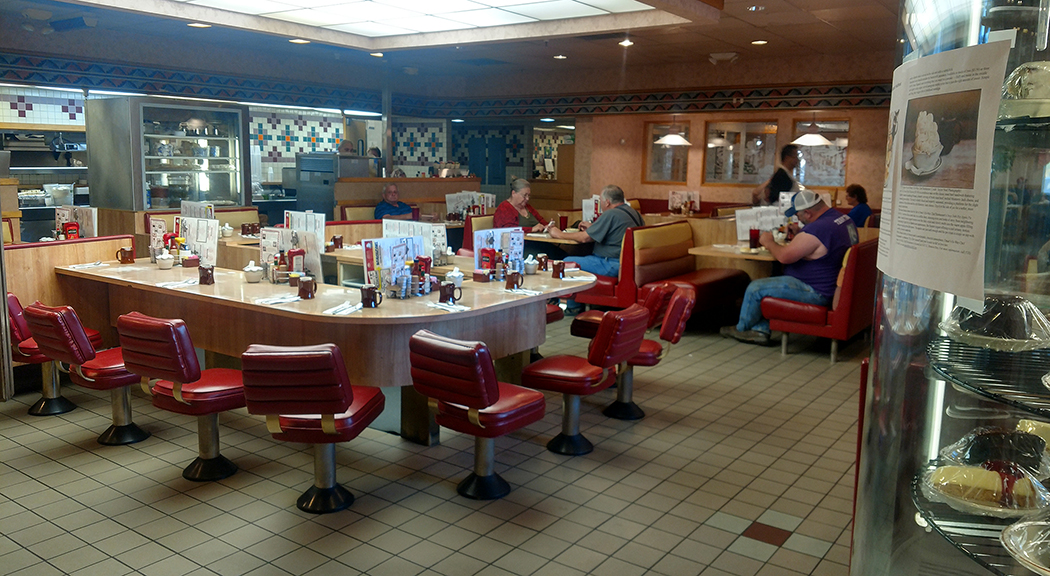
Ask a driver who ran flatbed in the nineties what changed, and you'll rarely hear "the trucks." You'll hear about the counter.
Most large truck stops used to have a sit-down restaurant with a professional drivers' section. There was a lounge with a TV and chairs that faced each other. There was a CB you actually used, because you had to as it was the only way to find out about the scale house at mile 214. You'd end up at the same three stops on the same lane, week after week, and you'd recognize faces. Not friends, exactly. But not strangers.
Most of that is gone. The restaurant became a fuel island with a self-checkout and a wall of coolers. The lounge became more retail square footage. The CB went quiet once everyone had a phone and an app that showed the same information faster. Nobody decided to make trucking lonelier. It happened one square foot at a time, for reasons that made sense on every individual balance sheet.
The result shows up in the research. A widely cited survey of long-haul drivers found that 27.9% reported loneliness and 26.9% reported depression, alongside chronic sleep disturbance (20.6%) and anxiety (14.5%). A 2026 study in Occupational Medicine of 652 long-haul drivers went further and traced the mechanism: job stress doesn't lead straight to depression. It runs through loneliness and through the erosion of social support. Those two things are the pipe the damage travels down.
Industry reporting has been saying the same thing for years. FleetOwner's look at driver isolation found that boredom and disconnection push drivers toward the whole catalog of bad substitutes: online shopping, fast food, alcohol and that the pandemic made a long-standing problem considerably worse.
That distinction between stress and isolation matters more than it sounds like it does.
Trucker Loneliness Is Not A Willpower Problem
The standard advice for driver isolation is some version of reach out more. Call your wife. Text your buddy. Don't isolate yourself.
It's not wrong. It's just aimed at the wrong layer. Telling a solo owner-operator to reach out more is like telling someone in a town with no roads to drive more. The effort isn't the missing ingredient.
There's a useful frame for this that comes out of work on community design rather than trucking. The argument, laid out by Relational Infrastructure, is that connection is mostly a byproduct of structure, not of intention. The friendships in your life didn't come from you deciding to make friends. They came from something that put you around the same people repeatedly without either of you having to organize it: a shop floor, a church, a bowling league, a bar you both stopped at. When that structure exists, connection happens by default. When it's removed, no amount of individual effort replaces it, because you're now paying an organizing cost that used to be free.
This isn't a fringe view. The 2023 U.S. Surgeon General's advisory on loneliness and isolation put "strengthen social infrastructure" first among its six pillars: parks, libraries, community institutions, the physical and programmatic places that put people in proximity. The advisory treats disconnection as a public health problem with health risks it compares to smoking daily, and it locates the fix in the built environment rather than in individual effort.
Trucking is a near-perfect case study. The industry didn't get less social because drivers got less sociable. It got less social because the recurring, low-effort places where drivers overlapped were systematically removed such as the counter, the lounge, the CB channel, the same-lane regularity that scheduling software has since optimized away.
For owner-operators the hole is deeper still. A company driver at least has a dispatcher, a terminal, an orientation class, other people wearing the same logo. Run your own authority and you've got a business with one employee, a phone full of brokers who are transactions rather than relationships, and no colleagues at all. You've traded a boss for genuine independence. What doesn't show up in the settlement statement is that you also traded away the last structure that was putting people in your path.
How To Become Less Lonely As A Trucker Driver
If the problem is missing structure, the fix is building structure and not trying harder at spontaneity. A few things that work:
- Make one thing recurring instead of occasional. A standing Sunday 7pm call with your brother beats "we should catch up sometime," and it isn't close. The recurring version survives bad weeks, because nobody has to decide to initiate it. Occasional contact dies the first time you're too tired. Pick one person and one slot, and let it be short.
- Run repeat lanes on purpose when you can price it. Dedicated and regional work is usually framed as a home-time decision. It's also a relationship decision. Running the same corridor means the same shippers, the same receivers, the same dock guys, the same overnight stops. Those aren't friendships and don't need to be instead they're the weak ties that make a week feel populated instead of empty. If two loads pay within a few cents and one keeps you on familiar ground, that difference is worth something real that doesn't appear in the rate.
- Use the stops that still have somewhere to sit. They exist as independents, some of the older chains, a handful of state-run plazas. A stop with a real drivers' lounge or a sit-down counter is worth going ten miles out of route for, once or twice a week. You don't have to talk to anyone. Proximity does most of the work on its own, which is the whole logic of a third place.
- Join something with a meeting, not just a membership. OOIDA, state trucking associations, and owner-operator groups mostly exist as a card in your wallet. The ones with an actual calendar with a monthly meeting, a regional event, a members' call are the ones that function as infrastructure. Same principle for anything at home: a league, a congregation, a shop night. The requirement is that it happens on a schedule whether or not you organized it.
- Build the home side deliberately. Drivers with strong ties at home report the road differently than drivers whose entire social world was supposed to happen at the truck stop. If you're home four days a month, those four days carry disproportionate weight and you should protect a standing thing in them rather than leaving them unstructured and letting them fill with errands.
- Consider team driving honestly. It isn't for everyone and the schedule is brutal. But a spouse with a CDL, or a steady team partner, solves the isolation problem more completely than every other item on this list combined. Some drivers hate it. Some wish they'd done it a decade earlier. It's worth actually thinking through rather than dismissing.
When it's more than loneliness
None of this substitutes for treatment when something bigger is going on. Persistent hopelessness, drinking that stopped being social a while back, sleep that stays broken even on your home days means a schedule change won't touch any of that. Sleep especially. A review of sleep and mental health in truck drivers found the two are tangled together tightly enough that fixing one often moves the other.
If you're struggling, the 988 Suicide and Crisis Lifeline is available by call or text, 24 hours a day, anywhere in the U.S. The PrePass Safety Alliance keeps a list of mental health resources aimed specifically at drivers, which is a better starting point than a general search. Several carriers now include an employee assistance program that covers counseling, and a growing number of telehealth services will see you from the sleeper on a schedule that doesn't assume you're home Tuesday at 2pm.
The stigma in this industry costs drivers real money and occasionally their lives. And the version of toughness that says you handle it alone was built for a job that came with a counter full of guys who'd handled the same thing. That job's gone. Reading the road ahead and adjusting is what every driver already does for a living.
Looking for your next commercial truck or trailer?
Thousands of listings from sellers nationwide, no commissions.

Comments
Join the conversation
You need to login to your account to comment.
No comments yet
Be the first to share your take on this trucker tip.