
Utility Dry Van Trailers For Sale in Texas
Compare Utility dry van trailers for sale in Texas by floor rating, wall construction, tandem setup, and heat or water damage before choosing a van.
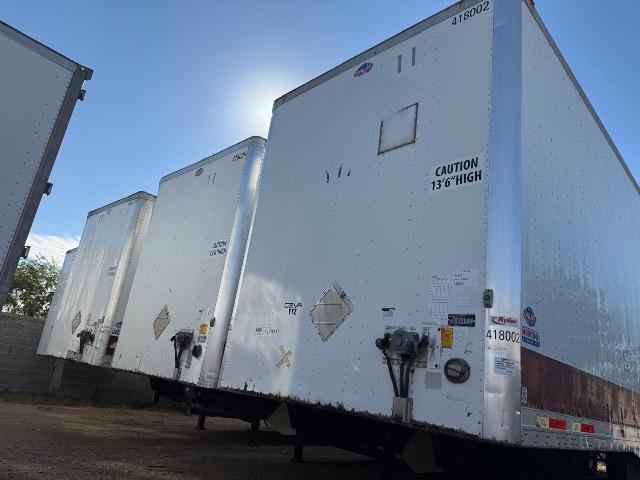

Selling a utility dry van trailer? List your utility dry van trailer for sale and reach thousands of commercial buyers.
Utility Dry Van Trailers in Texas
Floor capacity deserves more attention than an empty-weight comparison. Match the manufacturer's floor rating to the loaded forklift's axle loading, then inspect wood decking, crossmembers, threshold plates, and repairs around the rear entrance. Utility's 4000D-X and 4000D-X Composite configurations require checking the actual wall construction and logistics-post layout rather than assuming identical interiors. Scuff liners protect lower walls, while usable interior width and securement locations determine whether pallet patterns, load bars, or decking equipment will work. Exterior width alone does not establish cargo clearance.
Texas heat makes tire condition and inflation management important, especially on long highway runs between terminals. Inspect tire date codes, irregular wear, wheel ends, air springs, shock absorbers, and slider rails on used vans. Sliding tandems must move freely and lock positively at every pin; a frozen slider can prevent legal axle distribution even when total gross weight is acceptable. Gulf Coast humidity and exposure to coastal salt warrant close inspection of crossmembers, landing gear, wiring connections, and brake hardware. Roof seams and patches deserve a water-intrusion check after hail damage or previous repairs.
A newer model year does not guarantee disc brakes, automatic tire inflation, or a particular lining package. Verify the build sheet and component identification, then compare those specifications with maintenance records. On older Utility vans, concentrate on floor deterioration, rear-frame alignment, door seals, suspension bushings, and evidence of repeated patching. Request brake measurements, wheel-end service history, ABS fault information, and documentation for structural repairs.
For a new van, specify floor duty, door style, suspension, brake type, tire equipment, and aerodynamic devices around the intended freight and dock network. Confirm compatibility with dock restraints and the clearance needed at customer yards before ordering skirts or other low-mounted equipment. Obtain written warranty terms for the body and separately supplied running gear, including responsibility for approved repairs. The 12% federal excise tax generally applies to qualifying new heavy semitrailers at first retail sale, so confirm its treatment in the purchase paperwork. Compare used and new equipment on remaining service life and required refurbishment, not model year alone.
Frequently Asked Questions about Utility Dry Van Trailers in Texas
Should I choose swing doors or a roll-up door on a Utility dry van in Texas?
Swing doors usually provide more usable rear opening for full-height palletized freight, while roll-up doors suit frequent delivery stops where opening doors outside the trailer is inconvenient. On a Utility dry van, measure the actual clear opening and verify customer dock procedures. Roll-up door tracks and the overhead door assembly consume interior space and introduce rollers, cables, and springs that require maintenance.
How much weight can a Utility dry van legally haul in Texas?
A standard five-axle tractor and Utility dry van combination is generally limited to 80,000 pounds gross on Interstate highways, with 20,000 pounds on a single axle and 34,000 pounds on a tandem. Bridge-formula requirements, axle spacing, equipment ratings, and posted restrictions can reduce the allowable weight. Payload is the legal combination weight minus the actual tractor, trailer, fuel, driver, and equipment weight.
How do I check the ABS on a used Utility dry van trailer?
A functioning ABS warning lamp and a diagnostic scan are the starting points for checking a used Utility dry van's antilock braking system. Verify lamp operation according to the installed system's procedure, then inspect wheel-speed sensor wiring, connectors, and the trailer power supply. An ABS controller download can identify stored faults, but a clean report does not establish brake lining thickness, rotor condition, or proper mechanical adjustment.
Can a Utility dry van haul food products in Texas summer heat?
A Utility dry van can haul food products that the shipper approves for transport without temperature control, but an uninsulated van cannot maintain refrigerated temperatures in Texas heat. Confirm the product's temperature limits and sanitation requirements before assigning the trailer. Inspect for odors, pests, moisture, and residue from previous cargo; ventilation openings do not turn a dry freight trailer into refrigerated equipment.