
New Bucket Trucks For Sale
Shop new bucket trucks for utility, sign, tree, and lighting work. Compare working height, outreach, chassis class, body style, and controls.
Selling a new bucket truck? List your new bucket truck for sale and reach thousands of commercial buyers.
New Bucket Trucks
A key spec difference is telescopic versus articulated boom design. Telescopic bucket trucks are straightforward, stable, and well suited for road lighting, sign service, and jobs with clean access to the target. Articulated booms add up-and-over capability for working around poles, trees, and structures. Platform capacity is another practical separator. A 300 to 500 lb basket may be adequate for one technician and tools, while higher-capacity platforms support two workers or heavier material handling. Buyers should also compare turret rotation, basket rotation, boom stow position, lower and upper control layout, and emergency descent systems. If the truck will work curbside or in tight urban areas, outrigger footprint matters. X-pattern outriggers and narrow spread stabilizer designs can be a major advantage where setup space is limited.
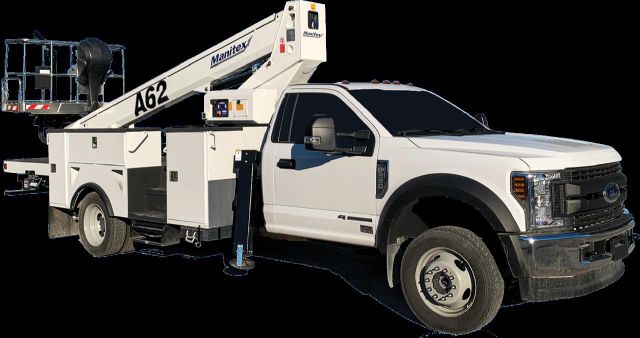
The chassis and body package deserve as much attention as the lift itself. New bucket trucks are commonly mounted on Ford Super Duty, RAM 5500, Chevrolet, International, or Freightliner chassis depending on lift size and intended duty cycle. Diesel power is still common for heavier builds, but gas engines can make sense for lighter municipal or contractor fleets with shorter routes and simpler maintenance needs. Service bodies with compartment storage are standard for electrical and utility work, while flatbed configurations fit contractors who need room for reels, conduit, signs, or bulky materials. Look closely at PTO setup, hydraulic system access, body corrosion protection, and whether the truck includes features like an electric jib winch, liner-ready basket, backup camera, and operator interlocks.
For buyers comparing new units, the real question is job match. A lighting contractor may prioritize a compact chassis, quick setup, and a 55 to 65 foot working height. A utility crew may care more about insulated boom construction, material handling capability, and storage for gear and grounds. Tree and vegetation applications often need more articulation and side reach than simple vertical access jobs. New equipment brings warranty coverage, current safety systems, and a clean maintenance baseline, but the best value still comes from choosing the right boom geometry, body layout, and chassis rating for the work mix. A bucket truck that is easy to deploy, properly rated, and built around the crew's daily tasks will return more uptime than a taller or heavier unit that adds complexity without solving the actual access problem.
Frequently Asked Questions about New Bucket Trucks
What is the difference between working height and platform height on a bucket truck?
Platform height is the height of the floor of the basket from the ground. Working height is typically calculated by adding about 6 feet to platform height to estimate the operator's reachable work area. Buyers should confirm how the manufacturer defines each number, because listings and brochures may use one term more prominently than the other.
Do all bucket trucks require a CDL?
No. CDL requirements depend primarily on the truck's GVWR, GCWR, brake configuration, and how the vehicle is operated under state and federal rules. Many lighter bucket trucks on Class 4 or Class 5 chassis are spec'd to stay below common CDL thresholds, but final body, lift, and tool load can change that. Buyers should verify the completed truck rating, not just the base chassis.
Are insulated bucket trucks necessary for every application?
No. Insulated booms and baskets are primarily used for energized utility and electrical work where dielectric protection is required. For sign service, lighting, communications, and general maintenance, a non-insulated bucket truck is often the more cost-effective choice. If line-clearance or utility work is part of the job, insulation rating, testing procedures, and ANSI compliance should be reviewed carefully.
What body style is best on a new bucket truck?
A service body is usually the best fit for fleets that carry hand tools, parts, meters, connectors, and safety equipment because enclosed compartments keep gear organized and protected. A flatbed works better when the job involves bulky materials, pallets, conduit, or sign panels. The best body style depends on how much of the day is spent doing aerial work versus hauling jobsite materials.
Which specs matter most when comparing bucket trucks for sale?
The most important specs are working height, horizontal outreach, platform capacity, boom type, chassis GVWR, and outrigger footprint. After that, buyers should compare rotation, insulation rating if applicable, storage layout, hydraulic controls, and serviceability. Those details have more effect on daily productivity than cosmetic differences or minor cab options.