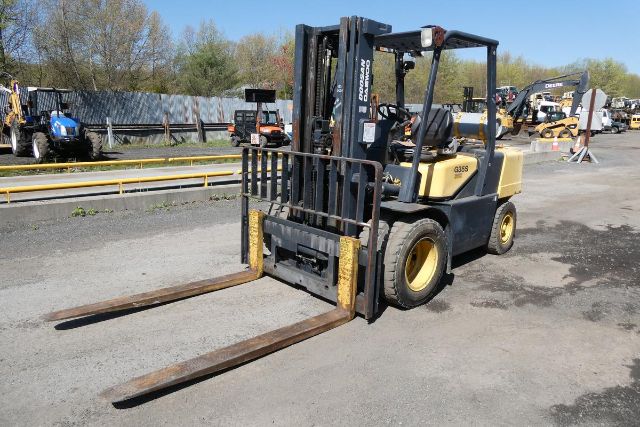
Daewoo Lifts - Fork For Sale
Browse Daewoo fork lifts for sale, including propane warehouse and yard forklifts with solid lift capacity, side shift options, and mast choices.
Learn moreHave daewoo lifts - fork equipment to sell? List it here to reach thousands of buyers.
About Daewoo Lifts - Fork
A common size range for Daewoo fork trucks is roughly 3,000 to 8,000 pounds of lift capacity, with larger pneumatic-tire models available for heavier outdoor work. Cushion-tire units are typically better for smooth indoor floors, while pneumatic or foam-filled pneumatic tires make more sense for uneven pavement, gravel yards, and mixed indoor-outdoor use. Mast configuration matters just as much as capacity. A two-stage mast can be a good fit for basic loading and unloading, while a three-stage or tri-mast gives more stacking height with lower collapsed height for trailer entry and overhead door clearance. Features such as hydraulic side shift, fork positioners, load backrests, and longer forks can make a major difference in handling pallets, machinery, crated freight, or building materials efficiently.
On Daewoo models, buyers often look closely at engine type, transmission behavior, brake condition, and hydraulic performance. Propane units remain popular because they are practical for indoor use with proper ventilation and offer quick refueling in high-cycle applications. Diesel models are often chosen for outdoor yards and heavier-duty use. Automatic transmissions are common on many industrial forklifts in this class, and smooth engagement under load is a key sign of a healthy machine. Hydraulic cylinders should be checked for leaks, mast rollers for wear, chains for stretch, and steer axle components for looseness. Hour meter readings help, but service history, cold-start behavior, lift speed, tilt function, and brake response usually tell more about the actual condition of a used fork truck than hours alone.
For trucking and freight operations, a Daewoo forklift can be a practical choice for dock work, truck loading, cross-docking, pallet staging, and yard support. Match the forklift’s lift height to your rack system or trailer loading needs, and confirm the true lift capacity at the load center you will actually be handling. Longer or heavier loads reduce effective capacity, especially at full mast height. Buyers should also verify overall width, overhead guard height, turning radius, and fork length so the truck fits the building, trailer, and material profile. A well-matched Daewoo fork lift can be a dependable, cost-conscious option for operations that need durable material handling equipment without unnecessary complexity.
Frequently Asked Questions
What should I check first when buying a used Daewoo forklift?
Start with rated lift capacity, mast configuration, fuel type, and tire setup. Then inspect the forklift under operation. Check cold starting, transmission engagement, brake performance, steering play, mast lift and tilt speed, side shift operation if equipped, and any hydraulic leaks at cylinders or hoses. Chain wear, mast roller condition, and the way the machine handles a load are more important than appearance alone.
Are Daewoo forklifts better for indoor or outdoor use?
That depends on the tire type and fuel system. Cushion-tire Daewoo forklifts are generally better on smooth indoor concrete, where tight turning and lower ride height matter. Pneumatic or foam-filled tire models are better for outdoor yards, broken pavement, and mixed-use sites. Propane models are common for indoor and dock work with proper ventilation, while diesel models are usually preferred for outdoor-heavy applications.
What is the difference between a two-stage mast and a tri-mast on a fork truck?
A two-stage mast is simpler and often suitable for standard loading and unloading where extra stacking height is not required. A tri-mast, also called a three-stage mast, provides higher lift reach while maintaining a lower collapsed height. That makes it useful for entering trailers, clearing overhead doors, and still reaching upper rack positions. The right choice depends on your building clearance and maximum stacking height.
How important is side shift on a forklift?
Side shift is a valuable attachment for pallet handling, trailer loading, and tight dock work because it allows the forks to move left or right without repositioning the entire machine. That saves time, reduces tire scrub, and improves placement accuracy in tight spaces. For operations handling trailers, racking, or frequent pallet movement, side shift is often considered a highly desirable feature rather than an extra.
Does forklift hour meter reading tell the full story on condition?
No. Hours are useful, but they do not tell the full condition of a used forklift. A higher-hour machine with documented maintenance, dry hydraulic cylinders, strong compression, and responsive controls can be a better buy than a lower-hour machine with neglected brakes, weak hydraulics, or transmission issues. Operational testing and service records usually provide a more accurate picture than the hour meter by itself.