
Used Peterbilt Vacuum Trucks For Sale
Browse used Peterbilt vacuum trucks, including sewer jetter and combo units, with specs on debris capacity, water volume, PTO setups, and GVWR.
Learn more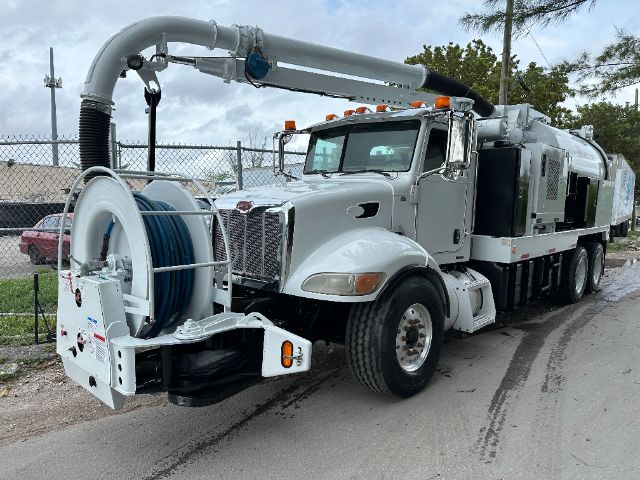
Have used peterbilt vacuum truck to sell? List it here to reach thousands of buyers.
About Used Peterbilt Vacuum Trucks
The most important spec decisions are debris body capacity, freshwater capacity, vacuum source, and water pump performance. Common debris bodies range from roughly 8 to 12 cubic yards on medium and heavy-duty Peterbilt chassis, while freshwater tanks often fall around 500 to 1,500 gallons depending on application. Buyers comparing combo units should pay close attention to jetter pump ratings in GPM and PSI, because a truck built for sanitary sewer flushing is different from one used mainly for lift station cleanup or storm drain work. Fan units and positive displacement blowers each have advantages, and used buyers should verify vacuum hours, PTO or pony motor operation, and maintenance history on the pump, boom, and hose reels. Rear door seals, hydraulic locks, hoist operation, and signs of tank corrosion matter as much as engine miles.
Peterbilt chassis are popular in this segment because they offer good vocational packaging, a durable cab structure, and broad parts support. Common engines include PACCAR PX-7 and PX-8 platforms, along with Cummins diesel options depending on year and configuration. Automatic transmissions are common on municipal and contractor-owned vacuum trucks because they simplify stop-and-go routing and operator training. Ex-municipal units can be attractive because they may have lower mileage for their age, but buyers should compare engine hours, idle time, and vacuum system wear instead of relying on odometer readings alone. A clean title, documented service records, and evidence of recent work on pumps, valves, hose reels, or the blower can significantly change the true cost of ownership.
A used Peterbilt vacuum truck should be evaluated as a complete working system, not just a truck with a tank. Check the chassis GVWR against payload needs, inspect the frame around body mounts and hoist points, and confirm axle ratings, brake spec, tire size, and suspension match the intended route and material. For sewer and environmental work, details like boom reach, rear door design, washout access, filtration, water level monitoring, and winterization can make one truck much more useful than another. If the truck is a combo jetter, verify usable hose capacity, reel drive performance, and pump pressure under load. These details determine how well the truck fits municipal contracts, septic service, stormwater maintenance, or industrial vacuum work.
Frequently Asked Questions
What should I look at first on a used Peterbilt vacuum truck?
Start with the vacuum body and pumping system before the chassis. Debris tank condition, rear door seals, blower or fan health, water pump output, hose reel operation, and hydraulic functions typically drive the largest repair costs. After that, review engine hours, PTO engagement, transmission performance, axle ratings, and any service records that show maintenance on the body manufacturer equipment.
Are Peterbilt vacuum trucks usually sold as combo units or straight vacuum units?
Many used Peterbilt vacuum trucks are combo units, which means they combine a debris body with a freshwater tank and a high-pressure jetting system. These are commonly used for sewer cleaning and storm drain maintenance. Straight vacuum units are also available and may be better suited for industrial cleanup, wet or dry material recovery, or applications where jetting capability is not needed.
Is mileage or engine hours more important on a used vacuum truck?
Engine hours are often just as important as mileage, and in many cases more important. Vacuum trucks spend a lot of time idling while powering PTO-driven systems, blowers, pumps, and hydraulics. A unit with modest miles but high idle and system hours may show more wear than a higher-mileage truck that spent more time on the road. The best evaluation compares miles, engine hours, vacuum system hours, and maintenance history together.
What body sizes and water capacities are common on Peterbilt vacuum trucks?
On used Peterbilt chassis, debris bodies often range from about 8 to 12 cubic yards, with freshwater capacity commonly between 500 and 1,500 gallons on combo units. Exact capacity depends on wheelbase, axle configuration, and intended job type. Larger tanks improve productivity on long municipal routes, while smaller units may be easier to maneuver in urban service work or tighter industrial sites.
Are ex-municipal Peterbilt vacuum trucks a good buy?
They can be, especially when the agency followed a documented preventive maintenance schedule. Ex-municipal trucks often have lower annual mileage and may have been serviced on a strict interval. The tradeoff is that they can accumulate substantial idle time, PTO hours, and operator wear from frequent stop-and-go use. A strong ex-municipal truck is one with clear maintenance records, good tank condition, and a vacuum system that has been tested under load.