
Kenworth Tow Trucks For Sale
Shop Kenworth tow trucks including rollback carriers and wreckers. Compare T280, T370, and T880 specs, GVWR, winch capacity, and upfit options.
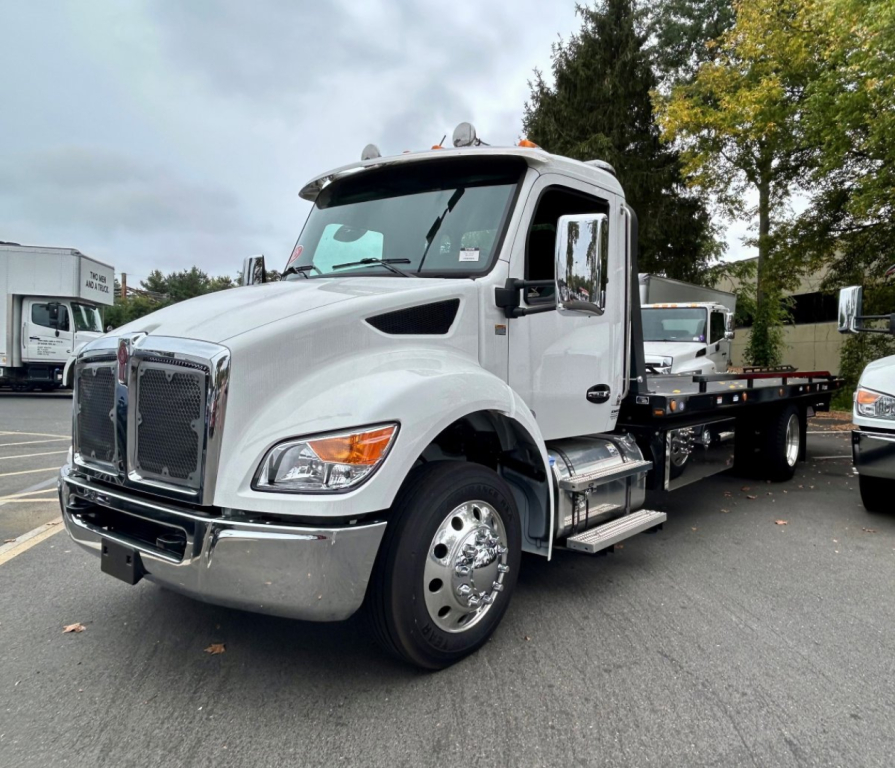
Selling a kenworth tow truck? List your kenworth tow truck for sale and reach thousands of commercial buyers.
Kenworth Tow Trucks
The first buying decision is usually body style and capacity. Many Kenworth tow trucks are equipped with Jerr-Dan rollback beds in 20-foot, 22-foot, or 28-foot lengths, often in low-profile XLP or LCG configurations for reduced loading angle. A 20-foot or 22-foot carrier is common for passenger vehicles, light trucks, and general roadside towing. A 28-foot industrial transporter on a tandem axle chassis is better suited for equipment hauling, larger vehicles, and jobs that demand more deck space and higher payload capacity. Buyers should compare deck material, dual-angle or shark deck designs, wheel-lift rating, winch capacity, headboard design, and toolbox layout. Common specs in this segment include 6-ton carrier ratings, 3,500-pound wheel lifts, and 8,000 to 20,000-pound winches depending on the body and intended use.
Powertrain and chassis spec matter just as much as the bed. Many Kenworth rollback tow trucks in this class are built with Cummins diesel engines and Allison automatic transmissions, a combination favored for stop-and-go towing service, driver familiarity, and easier operation in urban work. Around 300 horsepower is typical in medium-duty T280 applications, while heavy transporter setups can reach 450 horsepower on a T880. Pay attention to GVWR, axle ratings, suspension, brake type, tire size, and wheelbase because those details affect legal payload, stability, turning radius, and how well the truck matches the upfit. For heavier work, tandem rear axles, a 20,000-pound front axle, and a 40,000-pound rear are the kind of numbers that support industrial hauling and larger rollback bodies.
A well-spec'd Kenworth tow truck also tends to include the practical details that matter on long shifts and roadside calls. Air ride seating, heated mirrors, power accessories, differential locks, wireless bed remotes, work lights, strobes, hose reels, chain storage, and stainless dress-up components are common on modern units. Some specialized builds even use enclosed carrier bodies or cargo-style tow box conversions for secure transport and added storage. Buyers comparing Kenworth tow trucks for sale should focus on the match between chassis class, carrier length, winch and wheel-lift capacity, and the type of calls the truck will handle every day. A clean medium-duty rollback can be ideal for high-volume vehicle transport, while a heavier T880-based carrier is built for demanding commercial and industrial recovery work.
Frequently Asked Questions about Kenworth Tow Trucks
What Kenworth models are most common for tow truck and rollback applications?
The Kenworth T280, T370, and T880 are the models most often seen in tow truck applications. The T280 is a popular medium-duty platform for car carriers and rollback tow trucks, especially in 4x2 configurations with automatic transmissions. The T370 typically fills heavier medium-duty needs, while the T880 is commonly used for tandem axle industrial transporters, large rollback bodies, and heavier commercial towing work where higher GVWR and axle capacity are required.
What bed length is best on a Kenworth rollback tow truck?
The right bed length depends on the vehicles or equipment being hauled. A 20-foot or 22-foot rollback is common for passenger cars, pickups, and light fleet vehicles because it offers good maneuverability and a practical loading angle. A 28-foot bed is better suited for industrial transport, larger trucks, longer wheelbase units, and equipment hauling. Buyers should also look at bed width, deck height, and whether the carrier uses an XLP or low center of gravity design to improve loading performance.
What engine and transmission setup is common in Kenworth tow trucks?
Many Kenworth tow trucks are spec'd with Cummins diesel engines paired with Allison automatic transmissions. This is a common combination because it is well suited for frequent stops, tight maneuvering, and operators who need consistent performance across multiple drivers. Medium-duty rollback trucks often run around 300 horsepower, while heavier tandem axle transporters can be equipped with significantly more power. The transmission, rear axle ratio, and GVWR should all be reviewed together to make sure the truck fits the intended workload.
How important are winch and wheel-lift ratings on a rollback tow truck?
Winch and wheel-lift ratings are central to how useful the truck will be in daily service. An 8,000-pound winch is common on medium-duty carriers used for standard vehicle recovery and transport, while heavier transporter units may carry 20,000-pound winches for equipment and larger vehicles. A wheel-lift rating around 3,500 pounds is typical on many rollback builds and can add flexibility for towing combinations or repositioning vehicles. These ratings should always be matched to the type of calls, local operating conditions, and the truck's axle and frame capacities.
What should buyers inspect on a used Kenworth tow truck?
On a used Kenworth tow truck, inspect both the chassis and the towing equipment as separate systems. Review engine hours, mileage, transmission operation, brake condition, suspension wear, steering play, tire wear, and signs of frame stress or corrosion. On the carrier body, check hydraulic operation, deck condition, winch performance, wheel-lift wear points, remote functions, lighting, toolboxes, and any signs of structural repair. Service records for the truck and the upfit are especially valuable because rollback and wrecker equipment can see intensive duty cycles even when the chassis appears clean.