
Used Freightliner Rolloff Trucks For Sale
Used Freightliner rolloff trucks with cable hoist or hooklift, DD13 or Cummins power, tandem or tri-axle specs for waste, scrap, and demolition.

Selling a used freightliner rolloff truck? List your used freightliner rolloff truck for sale and reach thousands of commercial buyers.
Used Freightliner Rolloff Trucks
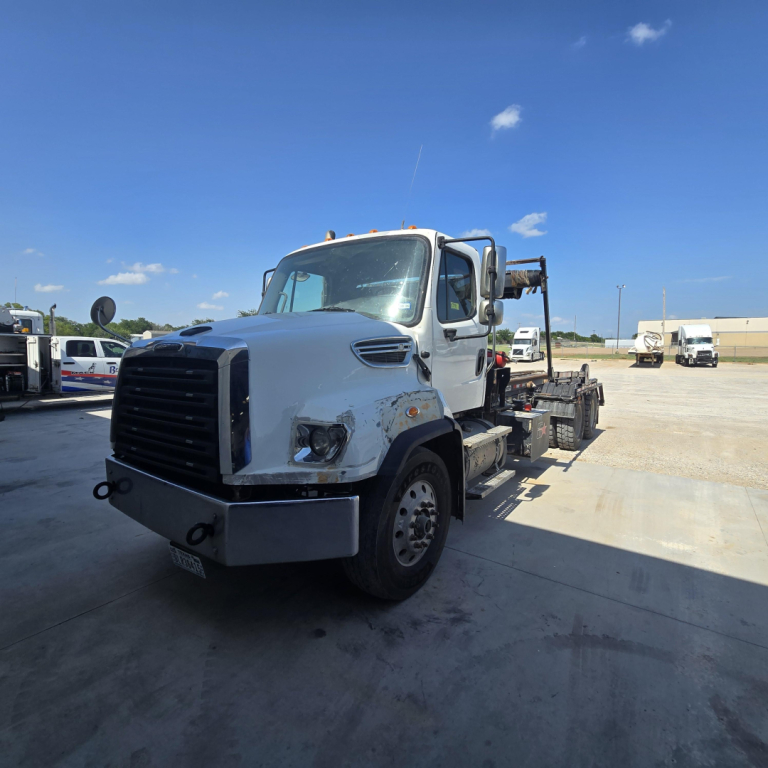
Freightliner gives you a wide chassis spectrum. M2 106 and 108SD are popular for municipal routes and tighter urban sites thanks to shorter wheelbases and good visibility. The 114SD and 122SD provide heavier frames, higher RBM, and room for longer rails and larger hoists. Power usually comes from Detroit DD13 or Cummins L9 and X12, matched to Allison 3000 or 4000 RDS automatics for stop-start duty, or Eaton Fuller 10 to 13 speed manuals for drivers who want more control on grades. Common axle sets include 18k to 20k steer with 40k to 46k tandems, and many units add a 13k to 20k pusher or tag for bridge weight and payload. Suspensions vary by route: Hendrickson Haulmaax or Chalmers for off-pavement abuse, and Freightliner AirLiner for a smoother highway ride.
Hydraulic performance defines daily productivity. Look for hot-shift PTOs feeding high-flow gear or piston pumps sized for quick hoist cycle times without excessive engine RPM. Larger hydraulic tanks help manage heat during back-to-back swaps. Check for dual-station proportional controls, good hose routing, protected valve banks, and stout hinge pins and bushings. Standard hook height on many hooklifts is 54 inches, and most cable systems conform to common container rail dimensions so boxes interchange across job sites. Many vocational builds include a pintle hitch and air or electric hookups for a pup trailer, plus automatic tire chains and high-capacity cooling for slow, heavy work.
Buying used means verifying the vocational iron as closely as the chassis. Inspect the hoist subframe for cracks at crossmembers, rear hinge ears, and doghouse welds. Measure cable wear and drum condition, and feel for play in sheaves and pins. Operate the tarp system through a full cycle to spot bent arms or leaking cylinders. Review aftertreatment history because refuse routes are idle-heavy and regen frequency matters; a healthy DPF and SCR system reduces downtime. Confirm lift axle legality for your state’s bridge laws, verify GVWR and axle ratings match your container weights, and check frame reinforcements or inserts where the hoist mounts. A rolloff that was spec’d right and maintained well will load cleanly, cycle fast, track straight with a full box, and keep crews safe and efficient day after day.
Frequently Asked Questions about Used Freightliner Rolloff Trucks
What is the difference between a cable hoist and a hooklift on a roll-off truck?
Cable hoists use a winch and cable to load standardized containers by pulling them up rails, which is robust for heavy, dirty jobs and commonly supports 20 to 40 yard boxes. Hooklifts use a hydraulic hook arm to pick and roll bodies on and off, giving faster swaps, better placement accuracy, and the ability to run multiple body styles. Cable systems generally excel in severe refuse and demo service, while hooklifts shine where speed, versatility, and tight site maneuvering are priorities.
Which Freightliner chassis is best for rolloff work?
For tight urban routes and municipal work, the M2 106 or 108SD offers a compact wheelbase, good sightlines, and ample power for 60k class hoists. For heavier loads, longer containers, or frequent off-road access, the 114SD or 122SD provides higher frame RBM, more cooling capacity, and space for larger hydraulic components. Match the chassis to your hoist capacity, container size, and weight targets, and pair it with vocational suspensions like Haulmaax or Chalmers when site conditions are rough.
What GVWR and axle configuration should I choose for a used Freightliner rolloff?
Most tandem rolloff builds run in the 60k to 66k GVWR range with a 20k steer and 40k to 46k drives. If your routes involve heavy C&D debris or you need to meet bridge laws while maximizing payload, a lift axle can raise legal weight and reduce pavement wear. Tri-axle or tandem with pusher or tag improves payload and stability but adds weight and complexity. Choose axle ratings, wheelbase, and suspension to balance turning radius, container length, and state weight regulations.
What should I inspect on a used rolloff hoist before buying?
Cycle the hoist under load and listen for chatter or pump whine. Check hinge pins, bushings, and sheaves for excessive play, examine the cable for flat spots or broken strands, and look for cracks at the subframe and doghouse welds. Verify hydraulic pump flow and pressure, PTO engagement, hose condition, and valve bank leaks. Inspect rear container locks, guides, and ICC bumper integrity. Run the tarp system fully and confirm cylinder seals are dry and arms are straight.
Can a Freightliner rolloff truck pull a pup trailer and what is required?
Many rolloff trucks are set up with a pintle hitch, wiring, and air lines to pull a pup, which helps shuttle empties and maximize route efficiency. Verify the hitch rating, drawbar eyes on the trailers you plan to use, and that service and emergency air circuits function correctly. Confirm GCWR, brake capacity, and axle ratings are adequate for combined weights, and check state and local regulations for length, axle spacing, and bridge compliance before putting a combination into service.