
Used Hino Hooklift Trucks For Sale
Used Hino hooklift trucks for sale. Compare payload, hoist capacity, wheelbase, PTO setup, and body compatibility for roll-off work.
Learn more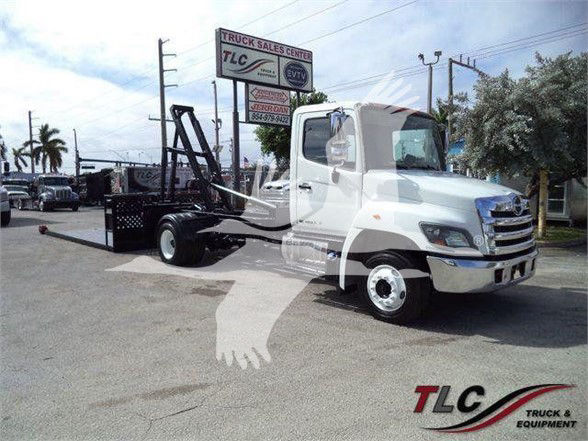
Have used hino hooklift truck to sell? List it here to reach thousands of buyers.
About Used Hino Hooklift Trucks
The first buying decision is usually hoist capacity matched to the containers you plan to run. Common hooklift ratings in this segment range from lighter 10,000 to 16,000 lb systems up into heavier medium-duty setups, and the actual working capacity depends on body length, load distribution, axle ratings, and wheelbase. A used Hino hooklift should be checked for PTO operation, hydraulic cycle speed, hoist wear, jib condition, rear roller condition, and frame reinforcement. Container length compatibility matters just as much as raw lifting power. Hook height, hook center, and body rail width must match the cans or interchangeable bodies already in your fleet.
On Hino chassis, buyers will often compare GVWR, front and rear axle ratings, brake type, suspension, and cab-to-axle dimensions before anything else. Models in the Hino medium-duty range are commonly set up as single-axle 4x2 trucks for tighter maneuvering and lower operating costs, though exact capability varies by model and body spec. A lower-profile chassis can be useful where loading angle, overhead clearance, and jobsite access are concerns. Transmission choice, rear axle ratio, and engine output all affect how well the truck handles stop-and-go routes, loaded container pickup, and highway transfers between disposal sites. If the truck will see frequent body swaps, pay close attention to hydraulic controls, in-cab PTO engagement, and any signs of stress around the subframe.
Condition matters more on a used hooklift than on many other truck types because the body and hydraulic system do as much work as the chassis. Inspect cylinder seals, hoses, valve bodies, pivot points, locking mechanisms, and electrical connections for tarping systems, work lights, or backup cameras. Check for frame rust, cracked welds, uneven tire wear, and signs of overloading near the hoist mounts. For buyers comparing listings, the best used Hino hooklift truck is usually the one with a documented maintenance history, a hoist sized correctly for the intended containers, and a chassis spec that leaves legal payload after the body is installed.
Frequently Asked Questions
What should I check first on a used Hino hooklift truck?
Start with the match between the truck and the containers you plan to run. Verify hoist rating, hook height, body length range, and axle capacity before looking at cosmetic condition. Then inspect PTO engagement, hydraulic cylinders, hoses, rear rollers, body locks, and frame reinforcement. A hooklift can look clean and still be a poor fit if the chassis is underspec'd or the hoist geometry does not match your containers.
Are Hino hooklift trucks good for urban and municipal work?
Yes, many Hino hooklift configurations are well suited for municipal, landscaping, recycling, and contractor applications where maneuverability matters. Medium-duty Hino chassis are commonly used in tighter streets, alleys, transfer stations, and jobsite environments where a single-axle truck has an advantage over a larger roll-off setup. The right wheelbase and cab-to-axle dimension can make a major difference in turning radius and body compatibility.
How do I know what hooklift capacity I need?
Choose capacity based on your heaviest loaded container, not the empty can size. The hoist rating must be considered alongside GVWR, front and rear axle ratings, wheelbase, and how the load sits during loading and transport. A heavier hooklift does not automatically mean a higher legal payload if the chassis or axle package is the limiting factor. It is important to evaluate the full truck-body-container combination rather than the hoist rating alone.
What are common wear points on a used hooklift truck?
The most common wear points are hydraulic cylinders, hose routing, pivot bushings, hook and jib contact areas, rear rollers, container locks, and the subframe where the hoist mounts to the chassis. Buyers should also inspect crossmembers, weld repairs, electrical controls, warning lights, and PTO function under load. Uneven tire wear and frame stress can indicate repeated overloading or poor load distribution.
Can one Hino hooklift truck run different body types?
Yes, that is one of the main advantages of a hooklift truck. The same chassis can often run open-top cans, flatbeds, dump bodies, landscape bodies, equipment platforms, or specialty containers if the rail spacing, hook height, and body length are compatible with the hoist system. This flexibility helps improve chassis utilization, but it only works well when body specs are standardized across the fleet.