
Ford Bucket Trucks For Sale in Ohio
Shop Ford bucket trucks for utility, telecom, sign, and municipal work. Compare F-550 and F-750 aerial units with common boom specs and features.
Learn more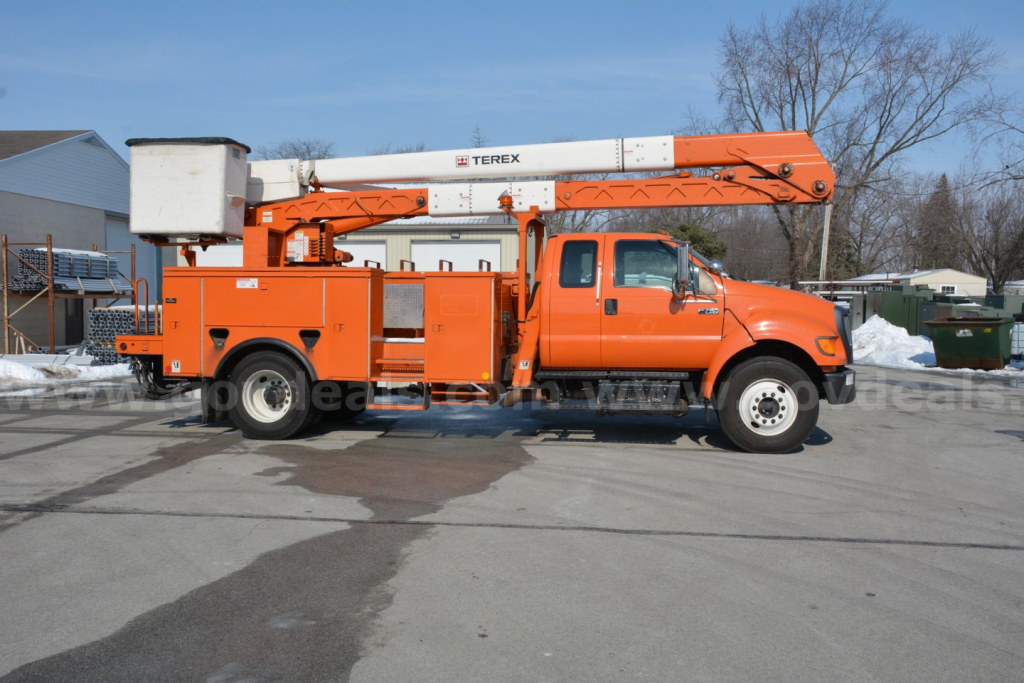


Have ford bucket truck to sell? List it here to reach thousands of buyers.
About Ford Bucket Trucks in Ohio
The boom and body package is what separates one Ford bucket truck from another. Common specs include working heights in the upper 30-foot to 50-foot range, platform capacities around 300 to 700 pounds, and either non-overcenter or overcenter boom designs depending on the application. Electric utility work may require an insulated boom, fiberglass inserts, current dielectric test records, and utility-style compartment bodies with inverters, receptacles, pole tool storage, and warning lights. Sign and lighting service fleets often focus more on maneuverability, reach, and body access than on line-clearance specifications. It is also worth checking whether the truck uses outriggers or torsion bar stabilization, since setup time, curbside access, and worksite footprint can change significantly between units.
Chassis choice matters in Ohio, where road salt, freeze-thaw cycles, and mixed urban-rural use can be hard on both the truck and the aerial device. Pay close attention to frame condition, cab corners, spring hangers, body floors, compartment doors, hydraulic lines, and the condition of any fiberglass body components. On used Ford bucket trucks, buyers should confirm PTO operation, hour meter readings if equipped, boom function smoothness, interlock performance, and recent service history on the aerial unit itself, not just the engine and transmission. A low-mileage truck can still have meaningful boom wear if it spent years in stop-and-set municipal or utility service.
Ford bucket trucks are also known as aerial lift trucks or cherry picker trucks, although the exact configuration can vary widely by fleet application. A compact F-550 can be the right fit for municipalities, contractors, and facility maintenance departments that need one truck to handle streetlights, signage, and general overhead work. A larger F-750 typically makes more sense when the priority is a bigger working envelope, higher basket capacity, or a more substantial utility body. The best buy is usually the truck with the right boom spec, insulation status, and service documentation for the work you actually do, rather than simply the newest chassis or the lowest miles.
Frequently Asked Questions
What is the difference between a Ford F-550 bucket truck and a Ford F-750 bucket truck?
A Ford F-550 bucket truck is generally a smaller, more maneuverable unit often used for municipal service, sign work, telecom work, and lighter utility applications. A Ford F-750 bucket truck is a heavier Class 7 chassis that can carry a larger aerial device, more body equipment, and higher platform ratings. The F-550 is often preferred where 4x4 capability and tighter access matter, while the F-750 is better suited to heavier boom packages and higher daily workload demands.
What should I check first on a used Ford bucket truck?
Start with the aerial device, not just the chassis. Confirm working height, platform capacity, insulation classification if required, dielectric test records, and that all boom functions operate smoothly through the full range of motion. Then inspect PTO engagement, hydraulic hoses, cylinders, pins, controls, interlocks, and stabilization equipment. After that, review the truck side for rust, engine condition, transmission performance, brake condition, tire age, and the state of the utility body compartments and flooring.
Are insulated Ford bucket trucks required for utility work?
Insulated bucket trucks are required for many electric utility and line-clearance applications, but not every overhead job needs an insulated unit. Streetlight maintenance, sign service, and facility work may use non-insulated aerial lifts depending on the task and the employer's safety requirements. If the truck will work near energized conductors, buyers should verify the boom insulation rating, confirm recent dielectric testing, and review any applicable ANSI and employer safety standards before putting the truck into service.
Is 4x4 important on a Ford bucket truck?
4x4 is most valuable on Ford F-550 bucket trucks that operate on unimproved roads, shoulders, easements, construction sites, or in winter conditions. In Ohio and similar climates, 4x4 can be useful for municipal and utility crews dealing with snow, soft ground, and roadside access. If most work is on paved streets and improved lots, a 4x2 truck may be enough, but buyers should weigh traction needs against higher purchase cost, added front-end components, and maintenance considerations.
How do boom height and platform capacity affect bucket truck selection?
Boom height determines whether the truck can safely reach the work without overextending or frequent repositioning, while platform capacity determines how much weight the bucket can carry including technicians, tools, and materials. A truck with a 37-foot to 42-foot working range may fit municipal lighting and sign work, while taller or heavier-rated units are often better for utility and more demanding overhead maintenance. Buyers should match the boom's actual working envelope and rated basket load to the job, because extra height alone does not guarantee the right side reach or lifting capability.