
Peterbilt Boom Trucks For Sale
Explore Peterbilt boom trucks with common specs, axle options, boom capacities, and service applications for utility, crane, and field work.
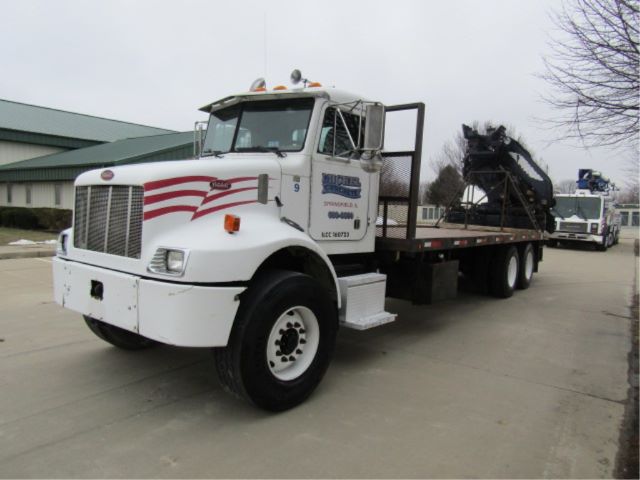
Selling a peterbilt boom truck? List your peterbilt boom truck for sale and reach thousands of commercial buyers.
Peterbilt Boom Trucks
The chassis spec matters as much as the boom itself. Wheelbase, front axle rating, rear axle ratio, and any tag or cheater axle can significantly affect body length, stability, and legal payload. Buyers should pay close attention to GVWR, frame reinforcement, and the relationship between crane rating and available payload once the body, compressor, welder, and bins are added. Diesel engine choice and transmission spec also matter in this class because boom trucks spend time idling, creeping on job sites, and running PTO equipment. It is common to see Cummins power paired with manual or automated transmissions, and an 8-speed or similar vocational setup can be a practical fit for mixed road and site work.
On the boom side, capacity is only part of the decision. Lift chart, maximum horizontal reach, hook height, turret design, and whether the unit has a personnel basket or material-handling configuration will determine how well it fits the work. Outrigger spread, hydraulic stability systems, and body layout are especially important for safe operation in tight urban areas or uneven ground. A buyer should also inspect service body condition, compartment integrity, hydraulic leaks, PTO engagement, and signs of frame stress around the mount points. If the truck will be used for utility or municipal work, lighting, backup camera systems, beacon packages, and operator controls can make a real difference in daily productivity.
Peterbilt is a strong fit for buyers who value a durable vocational cab, broad parts support, and a chassis that can be serviced by most heavy truck shops. When comparing listings, the best unit is not always the one with the biggest boom. It is the one with the right axle ratings, stable wheelbase, usable body configuration, and maintenance history for the work you plan to do. A well-matched Peterbilt boom truck can serve as a crane truck, service truck, and field support unit in one package, which is why this equipment class remains popular across construction, utilities, fleet maintenance, and infrastructure contractors.
Frequently Asked Questions about Peterbilt Boom Trucks
What should I look at first when buying a Peterbilt boom truck?
Start with the chassis ratings and the boom specification together, not separately. The front axle, rear axle, wheelbase, frame reinforcement, and GVWR determine how well the truck can support the body and crane under real working conditions. Then confirm the boom's lift chart, reach, outrigger setup, and body layout match the jobs you expect to do. A truck with the right stability, payload, and service body arrangement is usually more valuable than one with a higher advertised boom capacity alone.
Are Peterbilt boom trucks used more for material handling or personnel lifting?
They can be configured for either, but the intended use depends on the boom and body package. Some units are set up strictly for material handling with a hook, winch, and service body for tools and parts. Others may have personnel-lifting capability if the boom, controls, and safety equipment are designed and rated for that purpose. Buyers should verify the manufacturer's ratings, basket equipment, and applicable compliance requirements before assuming a boom truck can be used to lift people.
Why do axle ratings and wheelbase matter so much on a boom truck?
Axle ratings and wheelbase affect legal payload, body fitment, and jobsite stability. A longer wheelbase may allow a larger service body and better weight distribution, while heavier axle ratings can support the added mass of the boom, outriggers, and stored equipment. On some trucks, a tag axle or cheater axle can help with load distribution and compliance. These details directly affect how safely and efficiently the truck can travel and operate.
What maintenance areas are most important on a used boom truck?
Inspect the hydraulic system, PTO operation, boom controls, outrigger function, and the structural areas where the crane body mounts to the frame. Look for leaks, cracked welds, corrosion in compartments, and irregular tire wear that may indicate weight distribution or suspension issues. Engine hours can matter as much as mileage because many boom trucks spend long periods idling or running PTO-driven equipment. Service records for both the truck chassis and the boom assembly are especially valuable in this category.
Is a medium-duty Peterbilt boom truck a good choice for urban service work?
In many cases, yes. Medium-duty Peterbilt boom trucks are often easier to route, park, and position than larger crane trucks, especially in city environments or on restricted sites. With the right wheelbase, outrigger spread, and body design, they can handle sign work, utility repair, HVAC lifting, and general contractor support efficiently. The best fit depends on required reach, lifting capacity, and how much onboard storage and payload your crew needs.