
EXA Dump Trailers For Sale
Shop EXA dump trailers for scrap, demolition, and aggregate hauling. Compare frameless end dump specs, capacities, body materials, and suspension.
Learn more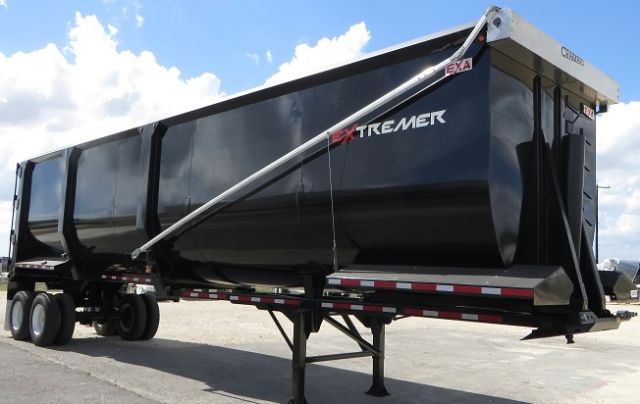
Have exa dump trailer to sell? List it here to reach thousands of buyers.
About EXA Dump Trailers
One of the first things to evaluate on an EXA dump trailer is body material and wall construction. Hardox steel bodies are common in heavy-duty scrap and demolition applications because they resist abrasion and denting better than mild steel. Buyers should compare body thickness, front and gate material, internal stiffening, top rail design, and gate style. Barn door gates are common on demolition and scrap trailers because they handle bulky material well, while aggregate work may call for a different discharge setup depending on how the trailer is unloaded. Side wall height, overall trailer length, and body shape all affect real-world usable capacity, center of gravity, and loading efficiency.
Hoist and suspension specs are just as important as the box itself. Many EXA dump trailers in this class use a multi-stage hydraulic hoist and tandem axle layout with heavy suspension ratings suited for rough service. A strong suspension package, proper axle rating, and quality wheel ends help when the trailer is loaded heavy and cycles frequently. Dump angle is another key number. A higher, stable dump angle helps material clear cleanly, especially with sticky debris or mixed loads. Buyers should also look at kingpin area condition, landing gear, brake size, ABS setup, tire rating, and whether the trailer keeps a stable stance at full raise. For frameless trailers, signs of twisting, stress cracking, or floor fatigue around high-load points deserve close inspection.
For fleet buyers and owner-operators comparing EXA dump trailers for sale, the right choice comes down to commodity, route, and loading environment. Scrap and demolition work usually favor abrasion-resistant steel, tall sides, and rugged gate hardware. Aggregate or general construction hauling may put more value on faster cycle times, lower empty weight, or compatibility with existing tractor and hydraulic setups. It also helps to verify tarp options, ladder placement, lighting protection, mud flap design, and coating quality, especially if the trailer will spend time in corrosive or high-impact environments. A well-matched EXA dump trailer can deliver strong payload efficiency and long service life, but only when the body design and running gear fit the job.
Frequently Asked Questions
What is the main advantage of an EXA frameless dump trailer?
The main advantage of a frameless dump trailer is lower tare weight compared with many frame-type designs, which can translate into more legal payload. In scrap and demolition service, that weight savings can be valuable, but the trailer also needs a strong body, quality hoist, and suspension that can handle twisting forces and repeated heavy cycles. Frameless trailers are often a strong fit for operators who want maximum hauling efficiency and understand the demands of uneven terrain and high-center-of-gravity loads.
Are EXA dump trailers better suited for scrap and demolition or for aggregate hauling?
Many EXA dump trailers are well suited for scrap and demolition because of their heavy-duty steel construction, abrasion-resistant body materials, and high-capacity frameless designs. That said, suitability depends on the exact trailer specification. A trailer with tall sides, Hardox construction, and barn door gate hardware is usually geared toward bulky or abrasive debris, while aggregate operators may focus more on clean discharge, lighter tare weight, and cycle efficiency. The correct match comes from comparing body design to the commodity being hauled.
What specs matter most when comparing EXA dump trailers for sale?
The most important specs are body capacity, body material, wall and floor thickness, hoist type, dump angle, suspension rating, axle rating, brake size, tire capacity, and gate design. Buyers should also pay attention to overall length, side height, trailer weight, kingpin area construction, and how the trailer is configured at full dump. For abrasive loads, steel grade and wear resistance are especially important. For high-cycle work, suspension durability and hoist reliability should be near the top of the checklist.
How do I know if a dump trailer is built for abrasive materials?
A dump trailer built for abrasive materials will usually have an abrasion-resistant steel body such as Hardox, along with heavier floor and wall construction in high-wear areas. Internal bracing, reinforced gate structure, strong top rails, and durable coating systems also help the trailer stand up to scrap, demolition debris, and other punishing loads. Buyers should verify the actual steel grade and thickness rather than relying only on capacity numbers, because two trailers with the same cubic-yard rating can be built very differently.
What should I inspect on a used EXA dump trailer before buying?
On a used EXA dump trailer, inspect the body for cracks, buckling, floor wear, patch repairs, and signs of distortion around the hoist mounts, draft arms, suspension hangers, and kingpin area. Check the gate operation, hydraulic system, landing gear, brakes, wheel ends, tires, lights, and ABS components. On frameless units, structural fatigue and twist-related damage are especially important to catch early. A careful inspection should also confirm that the trailer's capacity, dimensions, and commodity setup still match the work it is expected to do.