
New Fontaine Double Drop Deck Trailers For Sale
No exact matches found for your search
Showing New Double Drop Deck Trailers instead.
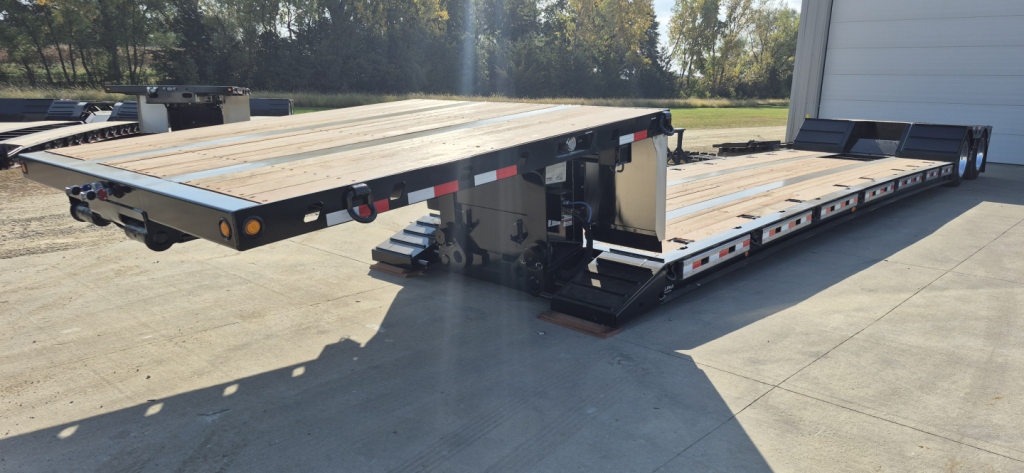
Have new fontaine double drop deck trailer to sell? List it here to reach thousands of buyers.
New Fontaine Double Drop Deck Trailers
Fontaine’s heavy haul lines commonly center around 40 ton to 55 ton configurations, with features that matter in real-world loading conditions. A mechanical detachable gooseneck is typically simpler and lighter, while a hydraulic detachable neck speeds up loading and reduces manual steps for operators handling equipment frequently. Many Fontaine double drops are spec’d with loaded deck heights around 18 to 20 inches, 29-foot well lengths, and air-ride suspension for better load protection and improved ride quality. On extendable models, open deck lengths can reach around 50 feet, which is useful for longer machinery or components that would otherwise force a different trailer class. Swing clearance is another key number to watch, especially when loading taller excavators, crushers, or machines with high front overhang.
Outrigger layout, axle configuration, and flip axle compatibility are where the trailer really needs to match the work. Buyers hauling mixed freight often want multiple pairs of outriggers for wider deck flexibility, plus rear connections for a close-coupled flip axle or spreader arrangement when bridge law or payload changes require it. Tandem and tridem setups each have their place depending on target weight, state routes, and permit strategy. Air lift axles, aluminum outside wheels, traction cleats on loading ramps, and wet-line or pony motor compatibility can all affect daily usability and long-term operating cost. Fontaine is well known in specialized hauling for durable frame construction, practical serviceability, and configurations that fit both owner-operator and fleet applications.
A good buying comparison starts with the freight itself, not just the ton rating on the brochure. Look at actual loaded deck height under payload, ground clearance, gooseneck swing radius, deck length closed and extended, and axle group spacing. Confirm whether the trailer is designed around legal payload optimization in your operating states or around maximum flexibility for varied permits and oversize work. For many buyers, a new Fontaine double drop deck trailer makes sense when uptime, lighter tare weight, and a proven heavy haul design matter as much as raw capacity.
Frequently Asked Questions about New Fontaine Double Drop Deck Trailers
What is the difference between a Fontaine double drop deck trailer and a lowboy?
The terms are often used interchangeably, but buyers should look at the actual configuration rather than the label. A double drop deck trailer has an upper deck, a dropped center deck, and a rear deck, which allows taller freight to ride lower than it would on a flatbed. In specialized hauling, many detachable gooseneck lowboys share this same basic layout, especially in Fontaine’s heavy haul lineup. What matters most is deck height, detachable neck type, capacity, axle layout, and whether the trailer is fixed or extendable.
Should I choose a mechanical detachable neck or a hydraulic detachable neck?
A mechanical detachable neck is generally lighter, simpler, and often less expensive to maintain, making it a strong choice for operations with predictable loading routines and experienced drivers. A hydraulic detachable neck improves loading speed and reduces manual effort, which can be valuable when equipment is loaded and unloaded frequently or when different operators use the trailer. The better choice depends on how often the neck is detached, the type of machinery being hauled, and whether ease of operation outweighs added system complexity.
What capacity should I look for in a new Fontaine double drop deck trailer?
Capacity should be matched to actual payload, axle setup, and the states where the trailer will run. Many buyers start with 40 ton class trailers for common equipment hauling, while 55 ton configurations and tridem setups are more appropriate for heavier machines or for operations that need greater flexibility with permits and bridge formulas. The trailer’s GAWR, GVWR, axle spacing, and compatibility with flip axles all influence legal payload more than the headline ton rating alone.
Why is deck height so important on a double drop trailer?
Deck height directly affects how much overall load height you can carry before running into clearance problems. An 18-inch to 20-inch loaded deck height can make a major difference when hauling excavators, pavers, forestry equipment, tanks, or other tall machinery. Lower deck height also improves stability by lowering the center of gravity, but buyers still need to balance that advantage against ground clearance and the kind of terrain the trailer will see at jobsites.
When does an extendable Fontaine double drop deck trailer make sense?
An extendable model is useful when freight length varies enough that a fixed well deck becomes limiting. Buyers moving longer machinery, modular components, or loads with unusual weight distribution can benefit from a trailer that runs compact when closed but opens up for longer cargo. The tradeoff is usually added weight and complexity, so an extendable trailer makes the most sense when load diversity justifies the extra capability.