
Used Freightliner Tow Trucks For Sale in Florida
Browse used Freightliner tow trucks in Florida, including M2 rollback carriers and wreckers with Cummins power, Allison automatics, and PTO setups.
No exact matches found for your search
Showing Used Freightliner Tow Trucks instead.
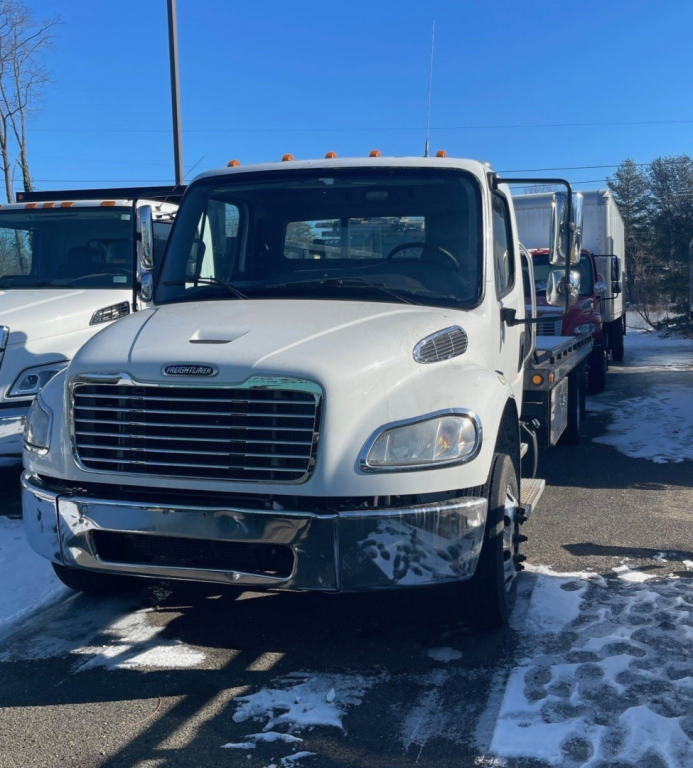
Have used freightliner tow truck to sell? List it here to reach thousands of buyers.
Used Freightliner Tow Trucks in Florida
The most important buying decision is matching the chassis ratings to the body and the work. Used Freightliner tow trucks in this class commonly range from non-CDL 26,000 lb GVWR carriers up to tandem-axle 60,000 lb GVWR units with 20,000 lb front axles and 40,000 lb rears. Engine choices often include the Cummins ISB 6.7L for lighter rollback applications and the Cummins ISL 8.9L for heavier carriers and wreckers, usually paired with an Allison automatic transmission. Air brakes, air ride suspension, double-frame construction, differential lock, and engine brakes are all worth prioritizing on heavier units. On rollback trucks, look closely at bed length and width, deck material, winch rating, hydraulic wheel-lift capacity, underbody toolbox layout, and rear stabilizer configuration. On wreckers, pay attention to boom rating, dual winches, free spool setup, hydraulic outriggers, wireless remote functions, and front winch bumper integration.
Freightliner tow trucks also appeal to buyers because parts availability and technician familiarity are generally strong, which matters on used equipment where uptime drives profitability. The M2 cab offers good visibility, straightforward controls, and a relatively tight turning radius for urban recovery work. In Florida, corrosion is usually less severe than in northern salt-belt markets, but buyers still need to inspect carrier decks, crossmembers, subframes, hydraulic lines, winch cables, wheel-lift pivots, outrigger boxes, and electrical connections for wear or poor prior repairs. On DEF-era trucks, confirm aftertreatment service history, engine hours, PTO operation, and idle time, especially on tow units that spend long periods running hydraulics on scene. A clean maintenance record on both the Freightliner chassis and the tow body is often more important than model year alone.
If the truck will spend most of its time hauling passenger vehicles, a low-profile rollback with a 6-ton class deck and a modest wheel lift may be the most efficient fit. If the operation includes box trucks, utility vehicles, or recovery work off the shoulder, heavier tandem-axle Freightliner tow trucks with larger booms, stronger winches, and more rear axle capacity make better sense. The right used Freightliner tow truck is less about the badge on the hood and more about how well the axle ratings, wheelbase, drivetrain, PTO setup, and tow body specifications line up with the jobs you actually bill for.
Frequently Asked Questions about Used Freightliner Tow Trucks in Florida
What are the most common Freightliner tow truck configurations on the used market?
The most common used Freightliner tow truck setup is the Business Class M2 106 with either a rollback carrier body or a conventional wrecker body. Rollback units are popular for light-duty and medium-duty transport because they can load low-clearance vehicles and general passenger cars quickly. Wrecker configurations are more common where recovery, roadside service, and hook-and-tow work are a larger part of the business. Buyers will also find both single-axle non-CDL trucks and tandem-axle trucks with much higher GVWR for heavier commercial work.
Is a Freightliner M2 106 a good chassis for a rollback or wrecker?
Yes. The Freightliner M2 106 is widely used in towing because it offers a strong medium-duty chassis, good parts support, and a cab design that works well in city and highway service. It is commonly spec'd with Cummins diesel power, Allison automatic transmissions, and PTO-ready drivetrains, which fit rollback and wrecker applications well. The platform also supports a wide range of wheelbases, axle ratings, and body sizes, so it can be configured for everything from a 22-foot carrier to a heavier tandem-axle recovery truck.
What should I inspect first on a used Freightliner tow truck?
Start with the chassis and the tow body as two separate inspections. On the chassis side, verify engine service records, transmission condition, brake type, suspension, frame integrity, tire wear, and any signs of excessive idle hours or PTO hours. On the tow equipment side, inspect the bed rails, deck, cylinders, hydraulic lines, pump operation, winches, wheel-lift function, boom structure, outrigger performance, lighting, and remote-control systems if equipped. A used tow truck can look clean cosmetically but still need expensive hydraulic, structural, or electrical work.
What GVWR and axle ratings make sense for a used Freightliner tow truck?
That depends on the vehicles being transported and the style of work. For routine passenger car hauling, a 26,000 lb GVWR single-axle carrier is common and can simplify CDL and operating costs in some situations. For medium-duty towing, commercial vehicle recovery, or longer rollback bodies, higher-rated single-axle or tandem-axle trucks are often a better fit. Front axle capacity, rear axle rating, wheelbase, and frame strength all matter because the real-world lifting and carrying forces on a tow truck are concentrated differently than on a straight truck with a standard body.
Are Florida used tow trucks a good option for buyers in other states?
They often are, especially because Florida trucks may have less exposure to road salt than similar units from northern states. That can be a benefit for frame condition, cab corrosion, and fastener life. Still, buyers should not assume every Florida truck is clean underneath. Coastal use, humidity, and heavy-duty recovery work can still create corrosion and wear. A proper inspection should include the frame, hydraulic components, electrical systems, deck structure, and all body mounting points regardless of where the truck spent its life.