
Crane Carrier Trucks For Sale
Shop Crane Carrier vocational trucks. Low-entry refuse, mixer, and roll-off chassis with Cummins power and Allison automatics built for severe duty.
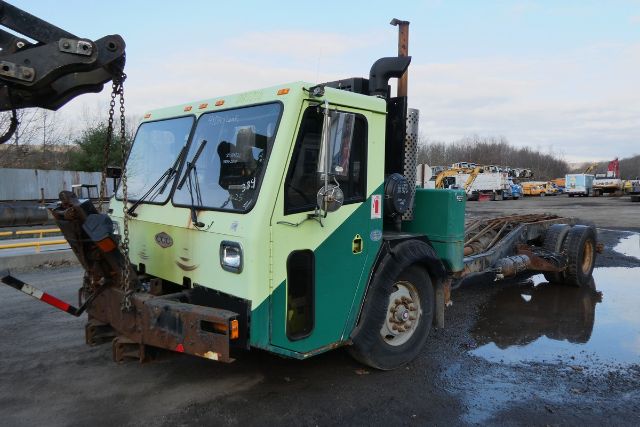

Selling a crane carrier truck? List your crane carrier truck for sale and reach thousands of commercial buyers.
Crane Carrier Trucks
Under the skin, these severe-duty chassis typically run Cummins power such as ISL and L9 in mid-GVW applications, and ISM, X12, or ISX for heavier specs. Allison 3000 and 4000 Series automatics dominate for durability in frequent shifting and PTO work. Expect front axles in the 18,000 to 24,000 pound range, tandems at 46,000 to 70,000, with 6x4, 8x4, and 8x6 layouts. Frames often use high RBM with double- or triple-rail reinforcement, front frame extensions for packer arms or plows, and factory PTO provisions. Suspensions are typically Hendrickson HaulMaax or Primaax, Chalmers rubber block, or heavy-duty walking beam for off-road and transfer station abuse. Brake systems are full air with ABS and traction control, and many builds include lift axles to meet bridge formulas. Recent models from Battle Motors, the current parent of Crane Carrier, also include battery-electric refuse variants for urban routes.
The technical advantage is customization for vocational duty. Tight-turn dual-steer cabs, body-builder friendly wiring, and robust frames make these chassis a good match for front loaders, side loaders, rear loaders, roll-offs, concrete mixers, vacuum and jetter trucks, street sweepers, and airport or municipal snow equipment. Trade-offs include higher curb weight and a stiffer ride compared to highway tractors, along with cab refinement that is focused on durability over long-haul comfort. Resale is strongest in markets that value low-entry refuse or mixer specs, and parts support revolves around major components from Cummins, Allison, Meritor, and Hendrickson, plus body-specific parts from OEMs like Heil, McNeilus, Labrie, or Galbreath. Aftertreatment systems on EPA 2010 and newer engines require proper regen strategy, which is critical in stop-start routes.
When comparing listings, match the chassis to the body and route. Verify GVWR, axle ratings, wheelbase, and CA or CT to ensure the hoist, mixer drum, or packer body will fit and stay within weight limits. Inspect frame rails for RBM ratings and any reinforcement, check front frame extensions and hoist mount areas for cracks, and measure kingpin and steering gear play on dual-steer cabs. For refuse bodies, compare chassis miles to engine hours, review DPF history, and look for hopper, trough, and floor wear. On roll-offs, inspect tower pins, sheaves, and hydraulics. Mixers should be checked for drum thickness, gearboxes, and chute wear. For electric units, confirm usable range on your route profile, charger compatibility, and remaining battery warranty, and factor in grants or utility rate structures.
Frequently Asked Questions about Crane Carrier Trucks
What applications are Crane Carrier trucks best suited for?
Crane Carrier chassis excel in severe-duty vocational work. The low-entry tilt cab is ideal for residential and commercial refuse collection with frequent stops, curbside operation, and tight alleys. The conventional COE vocational chassis is commonly used for roll-off hoists, concrete mixers, vacuum and jetter trucks, street sweepers, oilfield support, and municipal snow equipment that benefit from high front axle ratings, front frame extensions, and heavy RBM frames.
Which engines and transmissions are most common on Crane Carrier trucks?
Most units are powered by Cummins engines. Mid-range builds often use ISL or L9, while heavier-duty specs may have ISM, X12, or ISX. Allison 3000 and 4000 Series automatics are prevalent because they handle high PTO demands and constant stop-start operation with minimal driver fatigue. This combination delivers predictable performance and broad parts availability across North America.
How should I evaluate a used low-entry refuse chassis?
Balance miles with engine and packer hours, since route trucks can accrue significant idle time. Review DPF and SCR service history and confirm the unit can complete passive or parked regens as intended. Inspect dual-steer linkages, steering gears, and kingpins for play, and check frame rails, front frame extensions, and packer mounting points for cracks. Look for wear in the hopper, packer trough, and floor, and verify PTO, hydraulic pumps, cylinders, and hoses for leaks or heat damage.
Are parts and service readily available for older CCC units?
Support is generally strong because major components are industry standard. Cummins engines, Allison transmissions, Meritor axles, and Hendrickson suspensions have wide dealer networks and aftermarket coverage. Cab, frame, and electrical items are supported through Crane Carrier’s current parent, Battle Motors, while body parts come from the body manufacturer. For older units, provide the full VIN and body model to streamline sourcing.
Can a Crane Carrier chassis be re-bodied or repurposed?
Often yes, provided the wheelbase, CA or CT, axle ratings, and frame RBM meet the new body’s requirements. Verify PTO locations, hydraulic flow and pressure, electrical interface, and front frame extensions if needed. On roll-off or mixer conversions, double-check bridge law compliance and lift axle spacing. A detailed body-builder review of the spec sheet helps avoid costly rework and ensures proper weight distribution and performance.