
Landoll Other Trailers For Sale
Browse Landoll other trailers, including traveling axle and hydraulic tilt designs built for heavy equipment hauling and low load angles.
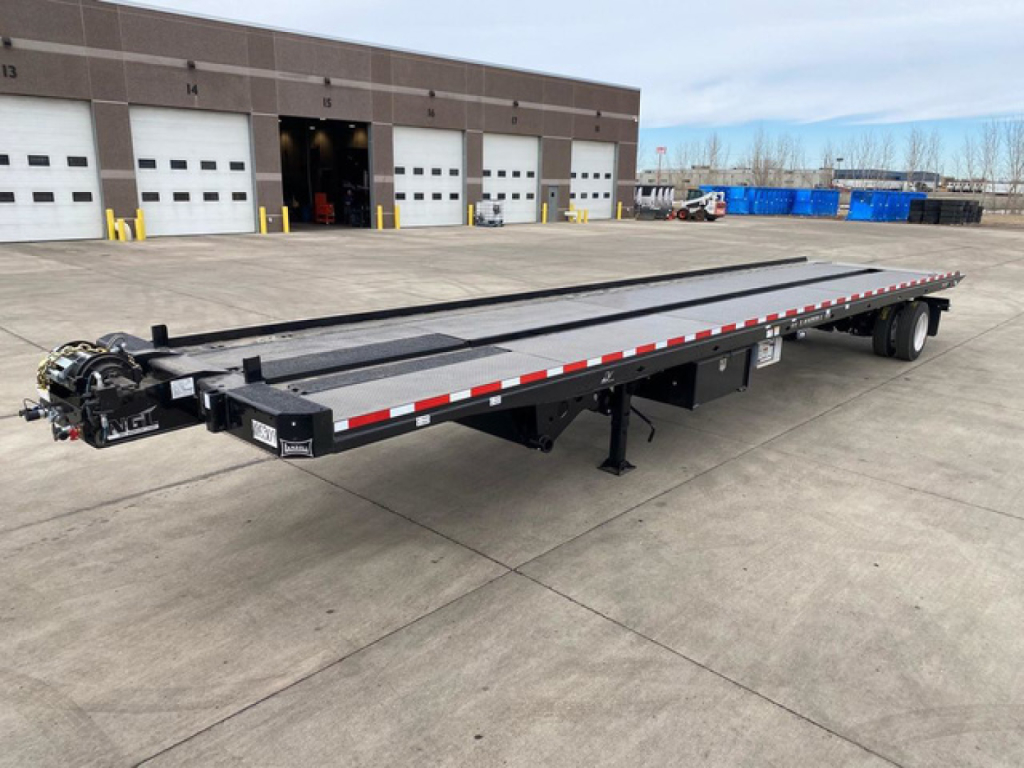
Selling a landoll other trailer? List your landoll other trailer for sale and reach thousands of commercial buyers.
Landoll Other Trailers
One of the biggest buying decisions is matching capacity and deck configuration to the equipment being moved every day. In this class, you will commonly see 50-ton range ratings, tandem axle layouts, steel construction, and hydraulic systems that control deck tilt, axle travel, and in some cases a winch. Lower deck length matters when hauling longer machines, while tail length and approach angle matter when loading low-clearance equipment. Kingpin setting and swing clearance are also important, especially for operators running shorter wheelbase day cabs or needing room between the trailer neck and tractor frame during tight turns. Apitong decking, traction plating, chain slots, and multiple tie-down points are common because these trailers are built around repeated machine loading rather than general palletized freight.
Suspension, tire package, and brake spec have a direct effect on durability and ride quality. Air ride is popular on Landoll trailers in this category because it helps protect equipment and improves load stability on rougher roads or jobsites. Buyers should also pay attention to axle ratings, tire size, manual or automatic tire inflation systems, landing gear capacity, and lighting package. Features like wireless remote controls, air ramps, work lights, strobes, and onboard tool storage add real operating value when the trailer is used in recovery work, night loading, or frequent solo operation. Loaded deck height and ground clearance need to be evaluated together because a trailer can load low equipment well but still need enough clearance for uneven entrances, rail crossings, and construction access roads.
Landoll has a strong reputation in this niche because these trailers are engineered for operators who need speed and versatility without giving up load security. For many fleets, a Landoll trailer fills the gap between a conventional flatbed and a true lowboy by offering faster loading and less dependence on external ramps or detachable configurations. The best choice depends on the mix of equipment, the weight distribution of typical loads, and how often the trailer will be used on pavement versus rough jobsite surfaces. If the freight regularly includes wheeled or tracked equipment with low ground clearance, the right Landoll setup can improve loading safety, reduce cycle time, and expand the range of machines a single trailer can handle.
Frequently Asked Questions about Landoll Other Trailers
What is a Landoll traveling axle trailer used for?
A Landoll traveling axle trailer is used to haul equipment that benefits from a low load angle and hydraulic loading system. Common applications include forklifts, aerial lifts, skid steers, compact excavators, rollers, pavers, and other self-propelled machines. The traveling axle design lets the deck tilt for loading without separate ramps, which speeds up the process and reduces the chance of low-clearance equipment hanging up at the transition point.
How do I choose the right capacity in a Landoll equipment trailer?
Capacity should be based on the actual operating weight of the equipment, attachments, fuel, and any additional cargo carried on the deck. Buyers also need to consider axle ratings, concentrated load placement, and the trailer’s lower deck length so the machine can be positioned correctly for axle balance. Buying strictly by advertised maximum capacity is not enough if the load has unusual weight distribution or if the machine must sit in a specific position to maintain legal bridge and kingpin weights.
Why do deck height and load angle matter so much on Landoll trailers?
Deck height and load angle directly affect what machines can be loaded safely and efficiently. Lower deck height generally helps with stability and clearance for taller equipment, while a shallow load angle is critical for low-ground-clearance machines such as scissor lifts, sweepers, or paving equipment. Tail length, axle travel, and approach design all influence the final loading geometry, so these specs matter as much as gross capacity for many buyers.
Are air ride suspensions worth it on this type of trailer?
Air ride is often worth the added cost on a Landoll trailer because it improves ride quality and helps protect both the trailer and the equipment being hauled. It can reduce shock transfer on uneven roads, improve stability for sensitive machines, and often works well with dump functions during loading. For fleets hauling valuable equipment or running mixed highway and jobsite routes, air ride is a common and practical choice.
What features add the most real-world value on a specialized Landoll trailer?
The most useful options are usually the ones that improve loading control, visibility, and uptime. Wireless remote controls for tilt and axle travel, a properly sized winch, air ramps, LED work lights, strobes, tire inflation systems, chain slots, and secure tool storage all make day-to-day operation easier. These features are especially valuable for owner-operators and small fleets where one driver may be handling loading, securement, and transport without extra ground support.