
Peterbilt Dump Trucks For Sale in Texas
Browse Peterbilt dump trucks for sale in Texas. Compare vocational specs, axle setups, body options, and heavy-duty performance for hauling jobs.
Learn more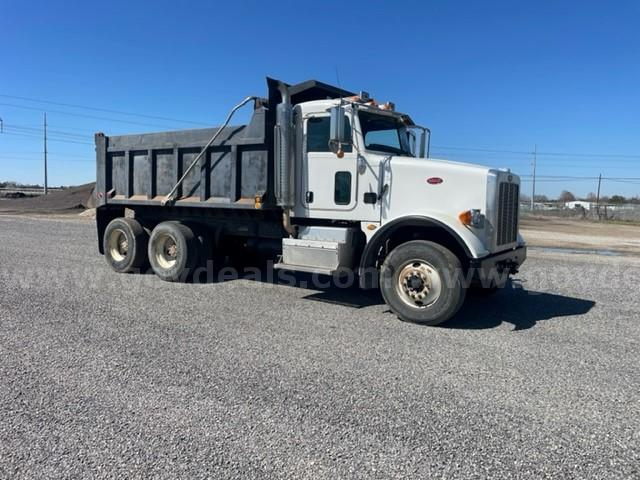
Have peterbilt dump truck to sell? List it here to reach thousands of buyers.
About Peterbilt Dump Trucks in Texas
A serious buyer should look closely at the truck's vocational spec, not just the make and model. Engine ratings, transmission type, rear axle ratio, suspension, and PTO configuration all affect how a Peterbilt dump truck performs on the job. Common setups include tandem axle dump trucks for general construction hauling and tri-axle configurations where higher legal payload is the priority. Automatic transmissions are common in municipal and mixed-driver fleets, while manual and automated manual options still appeal in heavier vocational use. Double frame construction, heavy front axles, locking rears, and vocational suspensions matter if the truck will spend time off-road, on uneven job sites, or under a loader every day.
Body specification is just as important as chassis specification. Buyers should verify body length, side height, material thickness, hoist type, tailgate design, and whether the truck has a half-round or square body. A half-round body is often preferred for sticky materials and easier cleanout, while a square body can be a better fit for varied material handling and straight-volume work. Other details that affect long-term value include tarp systems, pintle hitch or tow package, liner condition, hydraulic wet kit components, and the condition of the floor, crossmembers, and hinge points. On used Peterbilt dump trucks, uneven tire wear, frame corrosion, body cracking around stress points, and signs of chronic overloading deserve a careful inspection.
Peterbilt's reputation in the dump truck market comes from durable vocational platforms, good visibility, and a cab environment many operators prefer for long workdays. That matters in Texas, where trucks may run both highway miles and rough access roads between quarries, batch plants, and job sites. A well-matched Peterbilt dump truck can hold value well, but the best buy is the one with the right axle capacities, body spec, and maintenance history for the intended haul. Buyers comparing listings should focus on legal payload potential, ease of body service, driveline spec, and evidence that the truck was built for dump duty rather than converted into it later.
Frequently Asked Questions
What should I look for first on a used Peterbilt dump truck?
Start with the truck's vocational build sheet and weight-carrying components. Front axle rating, rear axle capacity, suspension type, frame configuration, PTO setup, and dump body specification tell you more than the badge alone. After that, inspect the body floor, hoist, hinge points, tailgate, hydraulic system, and frame rails for signs of cracking, twisting, or chronic overloading. Maintenance records and evidence of regular greasing, hydraulic service, and brake work are especially important on dump trucks because they operate in high-stress, stop-and-go conditions.
Are tandem axle or tri-axle Peterbilt dump trucks better in Texas?
It depends on payload goals and the routes the truck will run. Tandem axle dump trucks are common for general construction, paving support, and local hauling because they are simpler, lighter, and often easier to maintain. Tri-axle configurations can offer better legal payload potential when properly spec'd, which matters in aggregate and dirt hauling. The right choice comes down to Texas weight laws, bridge considerations, turning radius requirements, and whether the truck spends more time on-road or maneuvering in tight job sites.
Which Peterbilt models are commonly used as dump trucks?
The Peterbilt 365 is one of the best-known vocational platforms in the dump truck market, but buyers may also encounter other severe-duty Peterbilt models depending on year and application. The important factor is not just the model name but how the truck was ordered from the factory or upfitted later. A true vocational dump spec typically includes heavier axles, robust suspension, frame reinforcement, PTO and hydraulic compatibility, and components selected for off-road and construction service.
Is an automatic transmission a good choice in a Peterbilt dump truck?
An automatic transmission can be a very good fit for dump applications, especially in municipal fleets, urban hauling, and operations with multiple drivers. It reduces driver fatigue, simplifies training, and can improve consistency in stop-and-go work. For heavier vocational use, buyers should still confirm that the transmission is matched to the engine torque, axle ratio, and intended payload. In some applications, an automated manual or traditional manual may still be preferred for control, durability preferences, or fleet standardization.
How do I know if a Peterbilt dump truck was built for dump work and not converted later?
Look for indicators of an original vocational spec such as double frame rails, heavy front axle ratings, proper PTO and hydraulic integration, vocational suspension, factory or professionally installed body controls, and axle capacities that match the body and intended payload. A converted truck may still be usable, but shortcuts sometimes show up in wiring, frame modifications, hydraulic routing, or mismatched component ratings. A buyer should compare the body, hoist, and hydraulic system to the chassis ratings and look for documentation showing the truck was engineered for dump service rather than adapted after the fact.