
Sterling Boom Trucks For Sale
Browse Sterling boom trucks with utility-friendly chassis, diesel power, and body configurations suited for lifting, service, and municipal work.
Selling a sterling boom truck? List your sterling boom truck for sale and reach thousands of commercial buyers.
Sterling Boom Trucks
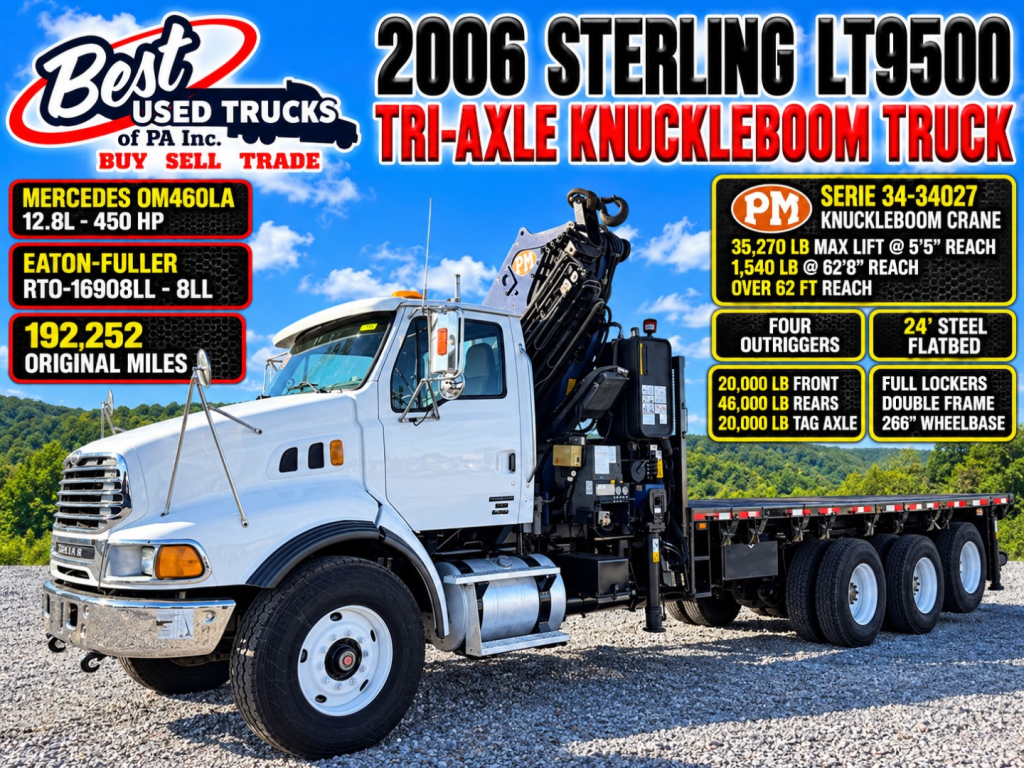
A key buying point on a Sterling boom truck is matching the chassis to the boom application. Some units are set up as material handling trucks with crane bodies, while others are configured more like aerial lift trucks for line work, lighting, or sign access. GVWR, front axle capacity, wheelbase, and suspension all affect stability and payload once the body and boom are installed. If the truck will spend time off pavement or on utility right-of-way, 4x4 configurations, ground clearance, and frame condition become especially important. Buyers should also look closely at hydraulic performance, PTO engagement, outrigger operation, and any signs of stress around body mounts or frame reinforcements.
Because many Sterling boom trucks came out of government and contractor fleets, service history can vary from highly documented preventive maintenance to basic in-house upkeep. That makes inspection critical. Check the boom structure for wear, corrosion, weld repairs, and smooth function through the full operating range. Confirm the condition of hoses, pins, bushings, rotation components, and control stations. On the chassis side, pay attention to engine hours versus odometer miles if the truck spent long periods idling at jobsites. Brake condition, steering play, tire date codes, and electrical system integrity also deserve attention, especially on older vocational trucks.
Sterling trucks remain relevant in the used boom truck market because parts and service support for common driveline components is still widely available, and the platform itself is familiar to many fleet technicians. For buyers comparing listings, the real value difference usually comes from the boom manufacturer, rated lifting or platform capacity, working height or reach, and the overall quality of the upfit. A clean Sterling chassis with the right axle spec, stable outrigger setup, and a well-maintained boom can still be a practical choice for specialized field work where simplicity and vocational durability matter more than late-model cab features.
Frequently Asked Questions about Sterling Boom Trucks
What should I check first when buying a used Sterling boom truck?
Start with the boom system and the chassis rating together, not separately. Verify the boom manufacturer, model, working height or lift rating, PTO and hydraulic function, and outrigger operation. Then confirm the truck's GVWR, axle capacities, wheelbase, and frame condition are appropriate for that upfit. A boom truck can look usable but still be a poor fit if the chassis is underspec'd, heavily corroded, or shows stress around mounting points.
Are Sterling boom trucks good for utility and municipal work?
Yes. Sterling chassis were widely used in utility, municipal, and contractor fleets because they were built for vocational service and commonly paired with specialized bodies. They are often a good fit for line work, lighting, sign service, tree work, sewer and vacuum applications, and general field maintenance. The best application depends on the installed boom or service body, drivetrain, and whether the truck needs highway speed, off-road traction, or stationary PTO performance.
Do older Sterling boom trucks still have parts support?
In many cases, yes. While Sterling as a truck brand is no longer in production, many of these units use widely supported engines, transmissions, axles, brake components, and other driveline parts from major OEM suppliers. Parts availability for the boom itself depends more on the boom manufacturer than on the truck make. Buyers should identify the chassis engine and transmission family, then separately confirm support for hydraulic, control, and structural boom components.
Is mileage the most important factor on a Sterling boom truck?
No. Mileage matters, but on vocational boom trucks, engine hours, idle time, hydraulic system wear, and maintenance quality can be just as important. A lower-mile truck that spent years idling on jobsites may show more wear in the engine, PTO, and boom system than a higher-mile truck with strong maintenance records. Condition, service history, and operational testing usually tell you more than odometer readings alone.
What chassis features matter most on a boom truck?
Front axle capacity, rear axle rating, wheelbase, frame strength, suspension, PTO compatibility, and braking performance are the main chassis considerations. If the truck will work on soft ground or undeveloped sites, buyers should also prioritize 4x4 capability, tire selection, and ground clearance. These features directly affect stability, legal payload, and how well the truck handles the added weight and leverage of a boom or crane body.