
New Fontaine Lowboy Trailers For Sale in Alabama
New Fontaine lowboy trailers for sale in Alabama. Compare 55-ton detach lowboys, deck lengths, load angles, axle setups, and hauling specs.
Learn more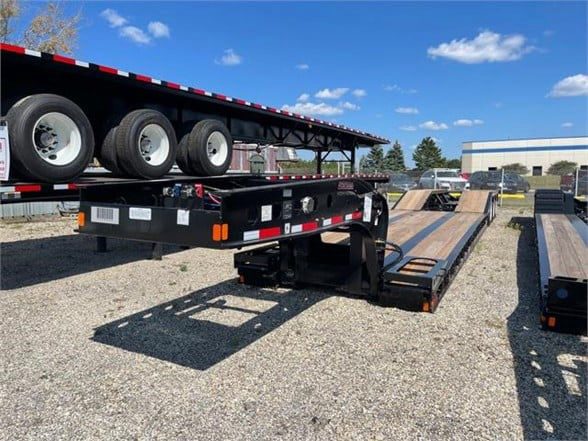
Have new fontaine lowboy trailer to sell? List it here to reach thousands of buyers.
About New Fontaine Lowboy Trailers in Alabama
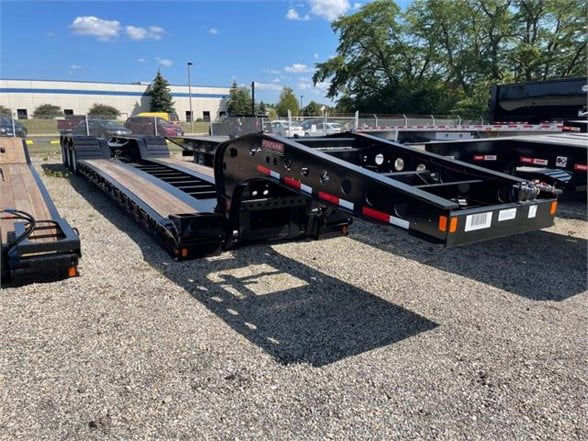
A buyer comparing new Fontaine lowboys should pay close attention to deck style and neck configuration. Flat low deck models are a strong choice for general heavy equipment hauling when you need a low loaded height and clean deck space. Roller paver styles use tapered main beams and gentler load angles to make loading paving equipment and other low-clearance machines easier. Common specs in this class include 24 to 26 foot deck lengths, loaded deck heights around 18 to 22 inches, triaxle rear bogies, and capacities in the 55-ton range, often expressed as 110,000 pounds in a defined deck length. A detachable neck, multi-position neck settings, rear ride height adjustment, flip-down ramps, and third axle air lift can all materially affect day-to-day usability.
Structural details matter because lowboy work is hard on trailers. Buyers often look for full outriggers, covered wheel areas, boom wells, lockable tool or chain storage, and axle spreads that match bridge and state operating needs. Tire size, rear axle compatibility, suspension type, and provision for a flip axle or close-coupled flip axle should be reviewed early, especially if the trailer may see varied machine weights or multi-state operation. In Alabama, application matters as much as raw rating. Roadbuilding fleets may prioritize roller paver geometry and low load angles, while contractors moving mixed iron may lean toward a more general-purpose flat deck lowboy with broader machine compatibility.
New Fontaine lowboys are typically chosen by buyers who want a known heavy-haul platform with straightforward specs and durable steel construction. The best fit is the trailer that matches the equipment you move most often, not the highest capacity on paper. Check the machine's track width, overall operating weight, ground clearance, and axle loading against the trailer's deck dimensions, distributed load rating, and neck and bogie configuration. That approach usually does more to improve uptime, loading speed, and permit compliance than adding options that do not match the work.
Frequently Asked Questions
What is the difference between a flat low deck lowboy and a roller paver lowboy?
A flat low deck lowboy is a more general-purpose heavy equipment trailer with a low, open deck suited for a wide range of machines. A roller paver lowboy is designed with loading geometry that better accommodates low ground-clearance equipment, often using tapered main beams and a gentler load angle. That makes roller paver styles especially useful for pavers, rollers, and similar machines that are easier to ground out on steeper approaches.
How do I choose the right lowboy capacity for my equipment?
Start with the actual operating weight of the machine, then check how the manufacturer rates the trailer over a specific deck length. A 55-ton lowboy may be rated at 110,000 pounds in a defined span, not across the entire deck in every loading scenario. You also need to account for attachments, buckets, counterweights, and how the load is distributed between the neck, deck, and rear bogie. Capacity on paper is only one part of the match.
Why does loaded deck height matter on a lowboy trailer?
Loaded deck height affects legal loaded height, center of gravity, and machine compatibility. A lower deck can help keep taller equipment under height limits and improve stability in transit. It also changes loading angles and ground clearance at transitions. For buyers moving excavators, dozers, and paving equipment, a difference of a few inches in deck height can materially change what can be hauled without special routing or disassembly.
What options are most important on a new Fontaine lowboy?
The most important options depend on the equipment mix, but detachable neck configuration, rear ride height adjustment, outriggers, axle lift, flip axle compatibility, and storage are among the most practical. Fleets hauling low-clearance machines often focus on load angle and deck design first. Fleets running varied heavy equipment often prioritize versatility, including deck width support, swing clearance, and axle arrangements that help with bridge compliance and permit planning.
Are triaxle lowboys a common choice for 55-ton hauling?
Yes. Triaxle lowboys are a common configuration in the 55-ton class because they balance payload capability, deck support, and overall maneuverability for construction and heavy equipment work. The exact usefulness depends on axle spacing, suspension setup, tire specification, and whether the trailer is built to accept a flip axle for heavier or more specialized loads. Buyers should review the complete axle group design, not just the axle count.