
Kenworth Box Trucks For Sale in Quebec
Compare Kenworth box trucks in Quebec. See T280/T380 and K270/K370 specs, GVWR, bodies, liftgates, and powertrains for urban and regional delivery.
Learn more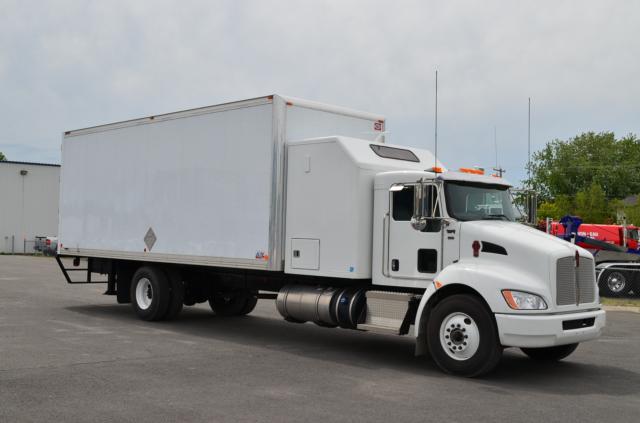
Have kenworth box truck to sell? List it here to reach thousands of buyers.
About Kenworth Box Trucks in Quebec
Powertrains typically center on PACCAR PX-7 or Cummins B6.7 for fuel economy and light weight, with PX-9/Cummins L9 available in higher GVWR builds. Expect 220 to 300 hp in city-spec units and up to the mid-300s for heavier bodies or hilly lanes. Allison automatic transmissions (2200/2500/3000 series) dominate stop-and-go work for smooth launches and reduced driver fatigue; Eaton manuals remain common where cost control and engine braking authority are priorities. Match axle ratios to duty cycle: shorter gearing for urban routes with frequent stops, taller for regional hops between Laval, Sherbrooke, and Trois-Rivières. Air brakes and an engine brake improve control on winter roads, while air ride suspensions protect freight and reduce driver fatigue compared with steel spring setups.
The van body is where profitability shows. Body lengths commonly range from 16 to 28 feet, in 96 or 102 inch widths, with FRP or aluminum sheet-and-post construction. Hardwood or laminated floors, logistics posts, e-track, and scuff liners extend life and speed securement. Roll-up doors save space at tight docks; swing doors seal better for longer highway legs. Tuck-under liftgates keep dock access clear, while railgates handle tall, palletized freight at curb height. Add curbside doors for parcel routes and translucent roofs for daytime visibility. For foodservice or floral, look for insulated bodies with Carrier or Thermo King units and shore-power plugs. In Quebec’s winters, block heaters, heated mirrors, higher-output alternators for liftgates, synthetic 5W-40, battery warmers, and all-weather harness sealing are practical upgrades. Given road salt exposure, aluminum bodies, stainless hardware, sealed connectors, and undercoating slow corrosion and protect residual value.
Driver-focused Kenworth cabs add daily efficiency with comfortable seating, smart switch layouts, and available ADAS like collision mitigation, ESC, and lane departure warning. Telematics and remote diagnostics streamline maintenance planning across provincial routes. Verify overall height for your loading docks and ensure the wheelbase supports the chosen body length and turning needs. The right Kenworth straight truck spec balances payload, maneuverability, and durability, shaving minutes at each stop while cutting lifecycle cost over Quebec’s mixed urban and regional lanes.
Frequently Asked Questions
How do I choose between a conventional Kenworth (T270/T280/T370/T380) and a cabover (K270/K370) for Quebec routes?
Pick based on space and visibility. Cabovers offer a tighter turning radius, better curb approach, and easier maneuvering in dense city cores with alley or side-street deliveries. Conventional models ride quieter at highway speeds, provide more engine and cooling options for heavier bodies, and are often preferred for mixed urban–regional work. If you’re mainly in downtown Montreal or Quebec City with frequent stops, cabover can pay off. If your day includes longer runs on Autoroutes with dock-to-dock freight, a conventional chassis is typically the better all-rounder.
What GVWR should I select for a Kenworth box truck and how does it affect licensing and payload?
Class 6 specs are common for city parcel and light freight with 16–22 foot bodies, while Class 7 supports 24–28 foot bodies and heavier palletized cargo. Higher GVWR increases legal payload and often brings air brakes and heavier-duty axles, tires, and frames. Licensing, brake requirements, and operating rules can change with GVWR and brake type, so confirm details with the SAAQ and your insurer before finalizing a spec.
Which transmission works best for stop-and-go delivery in winter conditions?
Allison automatics (2200/2500/3000) are favored for urban P&D because they deliver smooth, consistent launches, reduce driver fatigue, and integrate well with modern diesel aftertreatment. Pair the transmission with the right axle ratio for your route profile and consider an engine brake for better control on slick grades. If you run frequent highway miles with lighter loads, a manual can still make sense, but automatics generally improve productivity and driver retention.
What should I look for in the van body and liftgate on a Kenworth box truck?
Match body length and width to your freight and loading points. FRP or aluminum sheet-and-post bodies with scuff liners, e-track, and logistics posts handle daily wear. Roll-up doors save space at tight docks; swing doors seal better on highway routes. Tuck-under liftgates preserve dock access and are versatile for mixed operations, while railgates excel with tall, heavy pallets at curb height. Confirm platform capacity, bed height compatibility with your docks, and ensure your alternator and battery system support frequent gate cycles.
How should I spec a Kenworth box truck for Quebec winters and road salt?
Prioritize cold-weather and corrosion protection: block heater, heated mirrors, winter-rated diesel and 5W-40 synthetic, high CCA batteries with heaters, and robust alternator output for liftgates. Choose sealed wiring harnesses, stainless or galvanized hardware, aluminum bodies when appropriate, and quality undercoating. Air dryers and moisture management in air systems reduce freeze-ups on air-brake trucks. Good traction tires, proper weight distribution, and an engine brake also improve winter drivability.