
2023 Double Drop Deck Trailers For Sale
Shop 2023 double drop deck trailers built for heavy haul, tall equipment, and low deck height applications with detachable and fixed deck options.
Learn moreBrowse Double Drop Deck Trailers by Make

Have 2023 double drop deck trailer to sell? List it here to reach thousands of buyers.
About 2023 Double Drop Deck Trailers
For 2023 models, the most important spec decisions usually start with gooseneck style, capacity rating, and axle configuration. Mechanical detachable gooseneck trailers are popular for operators loading self-propelled equipment because they allow drive-on access without a separate ramp setup. Common ratings in this segment include 40 ton and 55 ton configurations, with tandem or tridem axle layouts depending on legal weight targets and intended freight. Air ride suspension, axle lift on the third axle, and wet-line readiness are common on newer heavy haul setups. Buyers should also look closely at clear deck length, swing radius, ground clearance, and axle spread, since those details affect both loading practicality and bridge law compliance.
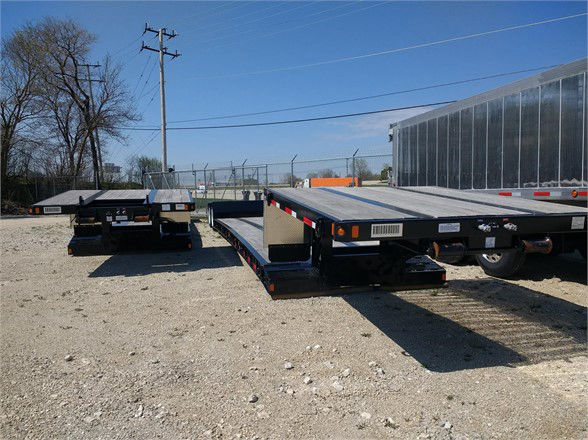
A well-spec'd double drop deck often includes outriggers, traction cleats on the front approach, durable polyurethane or similar corrosion-resistant coatings, and connection points for flip axles, flip boxes, or spreader bars. If the trailer will handle mixed freight, a flat level deck or extendable design can add flexibility for construction components, transformers, agricultural equipment, and other oversized loads. Aluminum outer wheels can help with tare weight, while steel construction is still common where durability and repairability matter most. Legal payload always depends on GAWR, GVWR, axle spacing, tractor setup, and the states you run in, so published ton ratings should be treated as a starting point rather than the final answer.
For many buyers, a 2023 model year hits a useful middle ground. It is new enough to include current design updates, cleaner wiring and plumbing layouts, and modern suspension and securement features, but broad enough to include both standard heavy equipment haulers and more specialized extendable configurations. The best choice comes down to what you load most often: excavators and pavers usually push you toward detachable goosenecks and low loaded deck height, while longer or more varied freight may favor a flat level deck, extendable well, or modular accessory compatibility.
Frequently Asked Questions
What is the difference between a double drop deck trailer and a lowboy?
In day-to-day trucking, the terms are often used interchangeably, especially for equipment-hauling trailers with a low center well. Technically, double drop deck refers to the trailer shape with an upper deck, lower deck, and rear deck, while lowboy is the broader heavy haul term many operators use for detachable and fixed-neck versions. When comparing listings, the practical questions are deck height, detachable versus fixed neck, axle count, and rated capacity.
What freight is a 2023 double drop deck trailer best suited for?
A double drop deck trailer is best suited for tall and heavy freight that cannot ride legally on a flatbed or standard step deck. Common loads include excavators, dozers, pavers, loaders, cranes, agricultural equipment, and industrial machinery. The low well helps keep overall loaded height down, and detachable gooseneck designs make loading wheeled or tracked equipment much easier.
How do I choose between a 40 ton and 55 ton double drop deck trailer?
Start with the heaviest machine or component you move regularly, then work backward through axle spacing, permit requirements, and the states where you operate. A 40 ton trailer may be a strong fit for general construction equipment and lower tare weight goals, while a 55 ton setup is better for heavier iron and more demanding specialized work. Capacity on paper is not the whole story, because legal payload depends on GAWR, GVWR, axle groupings, tractor spec, and any flip axle or booster configuration used.
Why does loaded deck height matter so much on a double drop deck trailer?
Loaded deck height directly affects whether a load can move legally without exceeding state height limits. Even an inch or two matters when hauling tall equipment. A lower deck height can reduce permit complexity, avoid route restrictions, and open up more legal hauling opportunities. That is why many buyers compare well height, ground clearance, and suspension design before they compare cosmetic features.
What features should I look for on a newer double drop deck trailer?
The most useful features depend on the freight, but many buyers prioritize detachable goosenecks, air ride suspension, outriggers, traction cleats, axle lift, corrosion-resistant finishes, and compatibility with flip axles or flip boxes. For mixed-use heavy haul, clear deck length and extension capability can be just as important as ton rating. It is also smart to review securement points, wiring protection, brake setup, and how easily the trailer can be serviced in regular fleet use.