
Yard Trucks For Sale in Pennsylvania
Browse yard trucks for sale in Pennsylvania, including terminal tractors and yard spotters built for trailer switching, port work, and DC operations.

Have yard truck to sell? List it here to reach thousands of buyers.
Yard Trucks in Pennsylvania
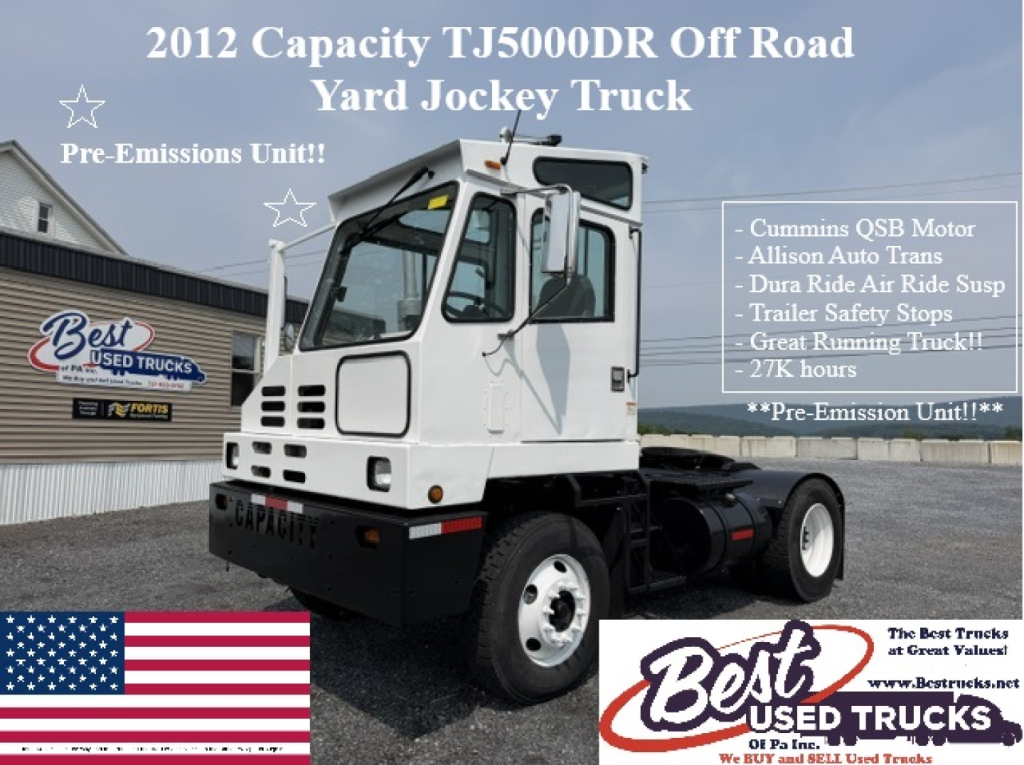
Most yard trucks on the market use a 4x2 single-axle layout, automatic transmissions, and medium-duty diesel engines in roughly the 170 to 200 horsepower range. Common combinations include Cummins QSB power with an Allison automatic, along with front axles around 12,000 pounds and rear axles around 24,000 pounds. Wheelbases are typically short, often around 116 to 125 inches, to improve turning radius in tight yards and loading lanes. Buyers should pay close attention to engine hours, transmission history, fifth-wheel lift operation, trailer stop function, and tire size because these units live in constant stop-and-go service and mechanical wear shows up differently than on over-the-road tractors.
The biggest buying decision is usually application. A basic off-road yard truck for private property use may be the right fit for a warehouse or plant that never leaves the yard. A street-legal terminal tractor may be necessary if the unit needs to cross public roads between buildings, terminals, or nearby lots in Pennsylvania. Cab configuration, visibility, air ride seat, air ride cab, A/C, and entry-exit ergonomics also matter because operators get in and out constantly during a shift. In cold-weather regions, heater performance, electrical condition, and traction-related items such as differential spec and tire condition deserve a closer look.
A good yard truck is less about mileage and more about uptime, maneuverability, and ease of operation. Look for strong cooling performance at idle, smooth brake response, consistent hydraulic lift speed, and a driveline that handles repeated trailer shuttling without harsh engagement. Pre-emissions units can appeal to buyers who want simpler systems, but overall condition, maintenance records, and parts support often matter more than model year alone. For many Pennsylvania fleets, the right yard spotter is the one that matches trailer volume, shift length, surface conditions, and the need, or lack of need, for on-road compliance.
Frequently Asked Questions about Yard Trucks in Pennsylvania
What is a yard truck used for?
A yard truck is used to move semi-trailers around a confined property such as a warehouse yard, distribution center, factory, or terminal. Its primary job is spotting trailers at dock doors, staging loaded and empty trailers, and making repeated short moves more efficiently than a road tractor. The hydraulic fifth wheel and short wheelbase are what make a terminal tractor faster and easier to use for this work.
What is the difference between a yard truck and a road tractor?
A yard truck is built for short-distance trailer switching, frequent entry and exit, and tight maneuvering, while a road tractor is built for highway travel, higher speeds, and long-haul comfort. Yard spotters typically have a shorter wheelbase, a hydraulically lifting fifth wheel, a cab designed for visibility, and gearing suited for low-speed work. Some are off-road-only units, while others are street legal for limited public-road operation.
Should I buy a street-legal or off-road yard truck in Pennsylvania?
That depends on where the truck will operate. If the unit will remain inside a private yard or plant, an off-road yard truck is often sufficient and can simplify the purchase decision. If the truck must cross a public street, travel between nearby properties, or operate in a port or terminal environment with road exposure, a street-legal terminal tractor is usually the better choice. Buyers should confirm lighting, brake, registration, and emissions requirements based on the exact operating area.
What should I inspect first on a used yard spotter?
Start with the fifth-wheel lift system, transmission operation, engine hours, brakes, and cooling system. A used yard truck spends its life in stop-and-go service, so smooth shifting, quick hydraulic response, stable idle temperature, and consistent brake feel are more important than odometer miles alone. Tire wear, differential performance, cab corrosion, and trailer stop function are also important because these items directly affect daily productivity and safety.
Are pre-emissions yard trucks better?
Pre-emissions yard trucks are attractive to some buyers because they generally have fewer aftertreatment components and can be simpler to maintain. That said, a pre-emissions unit is not automatically the better value. Overall condition, parts availability, maintenance records, hours, and prior yard use are usually more important than emissions status by itself. A well-maintained newer terminal tractor can outperform an older pre-emissions unit that has seen heavy switching duty without proper upkeep.