
New Ford Bus Trucks For Sale in Missouri
New Ford bus trucks for sale in Missouri, including shuttle and cutaway bus models with passenger, ADA, and non-CDL configurations.
Learn more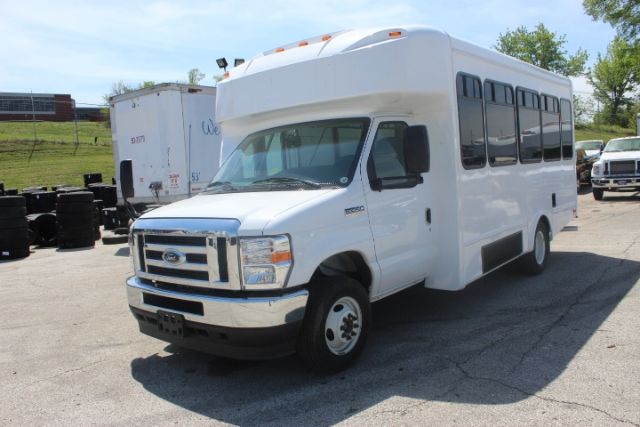
Have new ford bus truck to sell? List it here to reach thousands of buyers.
About New Ford Bus Trucks in Missouri
On new Ford bus builds, the chassis choice usually drives payload, ride quality, and body length. The Ford E-450 is especially common for shuttle applications because it offers higher GVWR capacity for heavier passenger loads, wheelchair lifts, and reinforced flooring. Body manufacturers then spec the coach with perimeter seating, forward-facing seats, rear luggage space, or mixed ADA layouts. Common features include automatic transmissions, dual rear wheels, heavy-duty alternators, rear air conditioning, daytime running lights, power passenger doors, and wheelchair lifts with securement positions. Buyers comparing units should pay close attention to passenger count versus wheelchair positions, door configuration, interior headroom, and how much cargo space remains when the bus is fully seated.
Missouri operators often need a bus that can handle a mix of city stops, rural roads, and year-round weather changes. That makes turning radius, brake feel, HVAC performance, and serviceability just as important as seat count. A Ford-based shuttle bus is often favored because parts availability and technician familiarity are generally strong, which helps reduce downtime. It is also worth checking axle ratings, suspension setup, tire size, and electrical capacity if the bus will run added loads such as destination signs, camera systems, or auxiliary climate control. For organizations trying to stay below CDL thresholds, non-CDL Ford bus configurations are common, but the final classification still depends on GVWR, passenger rating, and how the vehicle is equipped.
A good new Ford bus truck should match the route, not just the headcount. Short-hop senior transit and church transport may prioritize easy entry, ADA compliance, and visibility, while hotel and parking shuttle work may need faster loading, luggage room, and durable interiors that clean up quickly. Look closely at body construction, roof height, sidewall insulation, seat anchoring, and lift manufacturer support, because those details affect long-term durability more than the badge on the hood. Ford bus models remain popular because they give buyers a proven commercial chassis with a wide range of body options, from compact non-CDL shuttle layouts to higher-capacity passenger and mobility transport configurations.
Frequently Asked Questions
What Ford chassis is most common for a new shuttle bus?
The Ford E-450 is one of the most common chassis choices for a new shuttle bus because it provides strong GVWR capacity, dual rear wheels, and good support for passenger bodies with wheelchair lifts, HVAC systems, and commercial electrical loads. The E-350 is also used in lighter-duty applications, but many buyers step up to the E-450 when they need more seating, more equipment, or a heavier body build.
Can a new Ford bus be operated without a CDL?
Many new Ford shuttle bus configurations are built to meet non-CDL use, but that depends on the final GVWR and passenger capacity, not just the chassis model. Buyers should verify the completed vehicle rating, the exact seat count, and any state or federal rules that apply to their operation. A bus may be marketed as non-CDL in a certain seating configuration, but changes to seating or equipment can affect compliance.
What should buyers check on an ADA-equipped Ford bus?
On an ADA-equipped Ford bus, important checkpoints include the wheelchair lift brand and capacity, the number of securement positions, door opening dimensions, interior aisle width, and the seating layout when mobility positions are in use. It is also smart to review how the lift is serviced, where tiedown equipment is stored, and whether the floor structure and door area are reinforced for repeated commercial use.
Why are Ford bus trucks popular for church, senior, and community transport?
Ford bus trucks are popular in these applications because they combine a widely supported commercial chassis with flexible shuttle body options. Operators can spec a layout that fits small groups, mixed ambulatory and wheelchair passengers, or higher-capacity local transport without moving into a full-size transit bus. The result is a platform that is easier to maneuver than a large coach while still offering commercial-grade passenger service.
What features matter most on a new Ford bus in Missouri?
In Missouri, buyers often focus on HVAC performance, reliable cold-start operation, corrosion resistance, and a layout that works on both urban streets and rural routes. Suspension tuning, turning radius, step-in height, visibility, and service access are also important because many buses see frequent stop-and-go duty. A well-specced unit should match the terrain, trip length, and passenger mix rather than simply maximizing seat count.