
New Ford Bus Trucks For Sale
Shop new Ford bus trucks including shuttle and cutaway bus models with passenger seating, wheelchair lift options, and proven E-Series capability.
Learn more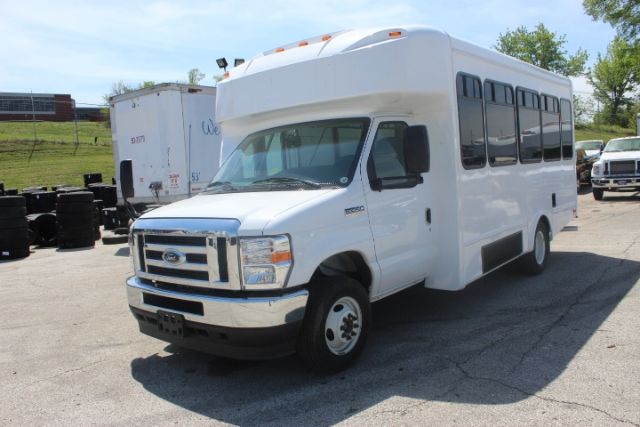
Have new ford bus truck to sell? List it here to reach thousands of buyers.
About New Ford Bus Trucks
The E-Series cutaway remains the backbone of this segment because it balances passenger capacity with manageable overall size. Common configurations include 12 to 16 passenger layouts, with many bodies designed to support ADA-friendly floorplans that trade some seating for wheelchair positions and a lift. New Ford bus trucks often come with automatic transmissions, gas powertrains such as the 7.3L V8, heavy duty alternators, and electrical systems sized for lift equipment, HVAC demand, door controls, and destination or safety lighting. Buyers should pay close attention to GVWR, axle ratings, interior headroom, luggage or rear cargo space, and the actual seated plus mobility-device capacity, since the posted seat count does not always reflect the working layout.
For many operators, the real buying decision is not just chassis brand but route profile. A Ford bus truck used for local stop-and-go senior transport or church service may prioritize easy entry, wheelchair lift reliability, and low-speed maneuverability. An airport or hospitality shuttle may put more weight on rear air conditioning performance, passenger door operation, suspension tuning, and driver visibility in tight loading zones. Service access matters too. Ford has a wide service footprint, and that is a real advantage for fleets trying to minimize downtime on passenger equipment that runs on fixed schedules.
New-condition Ford buses also appeal to buyers who want factory warranty coverage and current safety equipment from day one. Look closely at body manufacturer reputation, corrosion protection, sidewall and roof construction, wheelchair lift brand, and the quality of interior finishing in high-contact areas. On passenger equipment, durability shows up in seat mount integrity, stepwell construction, grab rail placement, HVAC output, and electrical reliability more than cosmetic trim. A well-spec'd new Ford bus truck should match the route, passenger count, accessibility needs, and maintenance plan without pushing the chassis beyond its intended duty cycle.
Frequently Asked Questions
What is the most common Ford bus truck chassis in this category?
The Ford E-450 cutaway is one of the most common chassis choices for new shuttle and small bus applications. It is widely used because it supports a broad range of passenger bodies, offers strong parts and service availability, and fits common non-CDL shuttle configurations. Body builders frequently pair it with 12 to 16 passenger layouts, wheelchair lift options, and commercial HVAC systems for local and regional passenger service.
Are new Ford bus trucks usually CDL or non-CDL?
Many Ford bus trucks are configured to stay in non-CDL territory, but the exact requirement depends on GVWR, passenger capacity, and how the bus is equipped. A common small shuttle layout may be designed for 14 passengers plus driver, which is often attractive to churches, senior centers, and community groups trying to avoid CDL-related staffing limits. Buyers should still verify state and federal rules, especially if the final body includes wheelchair positions, commercial use registration, or higher passenger counts.
What should I check on a new Ford shuttle bus besides seat count?
Seat count is only one part of the buying decision. Buyers should verify wheelchair lift capacity, ADA floorplan, GVWR, front and rear axle ratings, interior headroom, HVAC performance, door type, and available rear luggage or storage space. It is also important to confirm the actual usable passenger layout because a bus advertised with a certain number of seats may have a different real-world capacity once wheelchair positions, driver barrier space, or safety equipment are accounted for.
Is the Ford 7.3 gas engine a good fit for a shuttle bus?
The Ford 7.3L gas V8 is a strong fit for many shuttle bus applications, especially local and regional routes where simple maintenance and broad service support are priorities. It is commonly chosen for church buses, hotel shuttles, senior transport, and community transit because it delivers solid low-speed performance and avoids some of the added complexity buyers associate with diesel emissions systems. The best fit still depends on route length, idle time, terrain, and total passenger load.
Why do body manufacturer and upfit details matter on a Ford bus truck?
The chassis is only part of the vehicle. Passenger comfort, accessibility, and long-term durability are heavily influenced by the body builder and upfit components. Items such as lift brand, HVAC system sizing, body construction, corrosion protection, electrical integration, seating hardware, and stepwell design affect reliability and operating cost. Two Ford bus trucks with the same chassis can perform very differently depending on how the body was built and equipped.