
Used Freightliner Refrigerated Trucks For Sale in Pennsylvania
Browse used Freightliner refrigerated trucks in Pennsylvania. Compare reefer body specs, unit hours, liftgates, GVWR, and cold-chain features.
Learn more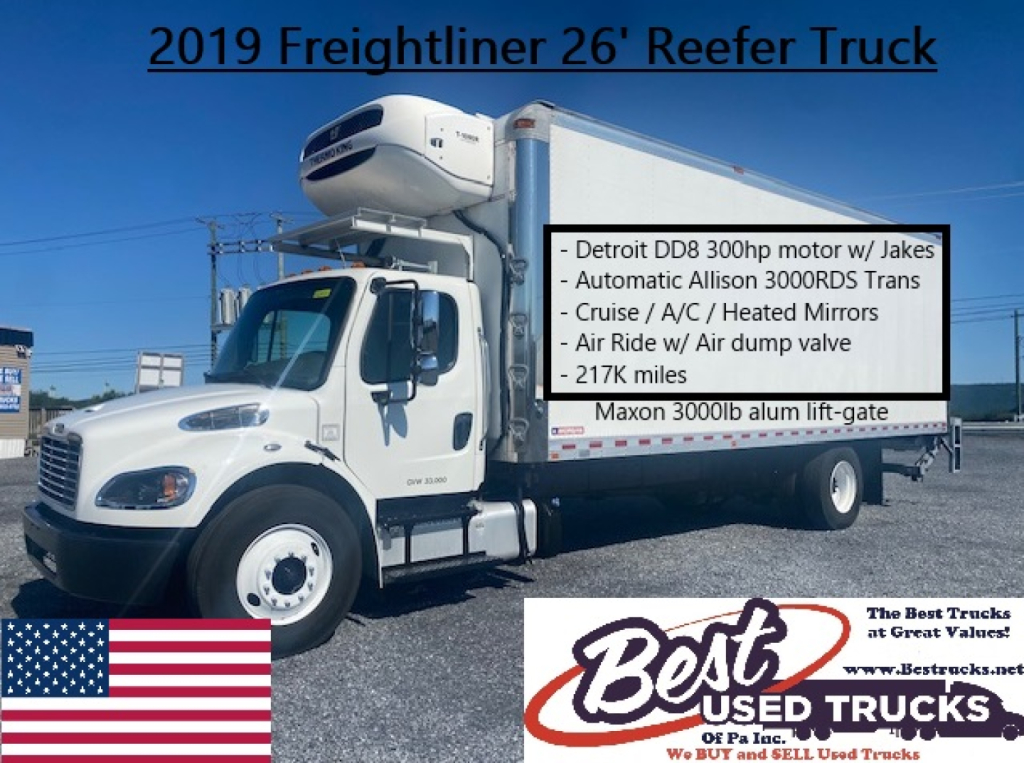
Have used freightliner refrigerated truck to sell? List it here to reach thousands of buyers.
About Used Freightliner Refrigerated Trucks in Pennsylvania
The refrigeration system matters as much as the chassis. Thermo King and Carrier units are the names most buyers look for, and reefer hours often tell more than truck miles about expected maintenance timing. It is worth checking whether the unit is diesel-driven or plug-in capable for standby use, how quickly it pulls down to target temperature, and whether the body is built for frozen, chilled, or produce applications. Insulation thickness, door seal condition, evaporator placement, and a ducted or channel floor all affect temperature recovery during frequent stops. If the operation handles mixed loads, look for a body with bulkheads or multi-temp capability.
On the truck side, Freightliner medium-duty refrigerated trucks commonly use diesel engines such as the Detroit DD8 in later models, often in the 260 to 350 horsepower range, backed by Allison automatic transmissions. For Pennsylvania buyers, that setup is well suited to stop-and-go delivery, hilly terrain, and driver turnover where ease of operation matters. Pay attention to GVWR, front and rear axle ratings, and payload after the reefer body and liftgate are factored in. Air brake spec, suspension type, differential lock, heated mirrors, and an air dump valve can all be useful depending on route density and dock conditions. Liftgates are especially important in this category, with many trucks equipped in the 2,500 to 4,000 pound range.
A good used reefer truck should be judged as a complete cold-chain package, not just a truck with an insulated box. Buyers should inspect reefer service records, body corner condition, floor wear, door frame corrosion, and signs of water intrusion around seams and the unit opening. It also helps to verify cargo box dimensions, interior height, pallet count, and how the body layout fits the intended product mix. Freightliner refrigerated trucks, also known as reefer trucks or refrigerated box trucks, are popular because parts and service support are generally strong and the chassis is familiar to many fleets and independent operators.
Frequently Asked Questions
What should I check first on a used Freightliner refrigerated truck?
Start with the refrigeration unit, body condition, and payload capacity. Reefer unit hours, service history, temperature pull-down performance, and signs of deferred maintenance are usually more important than odometer miles alone. Inspect the insulated body for floor damage, soft spots, door seal wear, water intrusion, and corrosion around the front wall and unit opening. Then confirm the truck's GVWR, axle ratings, and liftgate capacity to make sure the completed truck can legally and efficiently handle the intended load.
Are reefer unit hours more important than truck miles on a used refrigerated truck?
For many buyers, reefer hours are at least as important as truck miles because the refrigeration unit is a separate engine-driven or power-driven system with its own maintenance cycle. A truck with moderate miles but very high reefer hours may need unit service sooner than expected. The best evaluation combines both numbers with actual service records, including compressor work, belt and hose replacement, leak checks, and proof that the unit can hold the required temperature under load and during frequent door openings.
What box and chassis specs are common on used Freightliner reefer trucks?
In the medium-duty market, Freightliner refrigerated trucks are commonly built on M2-series chassis with 22 to 26 foot insulated bodies. Many are equipped with diesel engines in the mid-200 to mid-300 horsepower range and Allison automatic transmissions for route delivery. Common buyer-facing specs include side doors, aluminum or ducted floors, scuff liners, liftgates, air brakes, and single-axle configurations sized for foodservice, grocery, beverage, and local distribution work.
Is a Freightliner reefer truck a good fit for Pennsylvania delivery work?
A Freightliner reefer truck is often a strong fit for Pennsylvania because the platform works well in a mix of city streets, suburban routes, warehouse districts, and rolling terrain. Medium-duty Freightliner models are known for straightforward serviceability and wide parts support, which matters when uptime is critical in temperature-controlled delivery. Buyers running in winter conditions may also value specs such as heated mirrors, traction-oriented rear axle options, and a refrigeration setup that maintains stable box temperature during cold starts and repeated stops.
Do I need a liftgate on a used refrigerated truck?
A liftgate is essential if deliveries go to locations without docks or if freight is handled by pallet jack at stores, institutions, or small receivers. In the refrigerated truck market, liftgates also help reduce handling time and protect product integrity during multi-stop routes. The key is matching gate capacity and platform size to the actual load. A gate that is too small or underrated can slow the route, while the right gate improves delivery efficiency and expands the number of locations the truck can serve.