
New Kenworth Grapple Trucks For Sale
New Kenworth grapple trucks for brush, storm debris, waste, and municipal hauling, including key specs, crane setups, and chassis considerations.
Learn more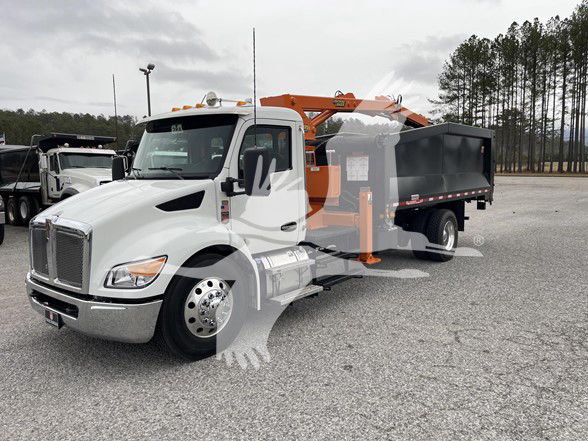

Have new kenworth grapple truck to sell? List it here to reach thousands of buyers.
About New Kenworth Grapple Trucks
A common configuration in this class uses a PACCAR PX-9 with around 300 hp, an Allison automatic such as a 3500 RDS, and aggressive rear axle ratios in the 5.57 range to improve low-speed launch and jobsite control. Reyco rear suspension is also a familiar spec on grapple builds because it supports body stability and helps manage uneven load conditions. Buyers should look closely at body length, hoist design if equipped, outriggers, hydraulic reservoir capacity, and the crane brand and model. A Peterson knuckleboom or Brushawg setup changes the truck’s working envelope, lift capability, and service profile. Tire size, wheel choice, and front axle rating also deserve attention because grapple trucks often carry significant weight forward when the loader is mounted behind the cab.
The best Kenworth grapple truck for sale is usually the one spec’d for the material stream you handle most. Tree and brush operations may prioritize fast cycle times, side height, and cubic capacity. Municipal and storm cleanup fleets may care more about durability, reach, cab visibility, and easy operator training. If the truck will spend time on pavement, in alleys, and on residential routes, turning radius and overall length become practical buying factors. If it will work on soft shoulders, transfer sites, or mixed terrain, suspension choice, traction setup, and axle loading are more important than appearance items.
New units appeal to buyers who want current emissions equipment, cleaner hydraulic integration, and a chassis that has not already absorbed years of crane stress. Kenworth’s vocational cab layout, parts support, and upfit-friendly platform make it a strong fit for grapple applications, also known in some markets as brush trucks, knuckleboom loader trucks, or debris loaders. When comparing listings, focus less on paint and trim and more on how the truck was engineered as a package: engine and transmission match, PTO and hydraulic capacity, legal payload, body construction, and how the crane placement affects balance, reach, and daily productivity.
Frequently Asked Questions
What is a Kenworth grapple truck typically used for?
A Kenworth grapple truck is typically used for loading and hauling brush, logs, storm debris, demolition debris, and other bulky material that is difficult to handle with manual labor alone. Many are used by tree service companies, municipalities, land clearing contractors, and waste operations. The grapple loader allows one operator to pick, load, and place material quickly, which improves jobsite efficiency and reduces the need for additional loading equipment.
What chassis features matter most on a new grapple truck?
The most important chassis features are axle ratings, wheelbase, frame strength, PTO compatibility, suspension, and the engine-transmission combination. Grapple trucks place unique stress on the frame because the loader creates concentrated loads during lifting and rotation. A properly spec'd wheelbase and rear suspension help maintain stability, while the right PTO and hydraulic setup ensure the crane performs correctly. Buyers should also confirm front axle capacity, because behind-cab loader installations can transfer substantial weight to the front of the truck.
Is the Kenworth T380 a common platform for grapple truck bodies?
Yes, the Kenworth T380 is a common medium-duty vocational platform for grapple truck applications. It is often selected for municipal work, tree service, and debris hauling because it can be configured with suitable wheelbases, automatic transmissions, vocational suspensions, and engines like the PACCAR PX-9. Its size makes it practical for urban and suburban routing while still providing enough chassis capacity for many popular grapple and debris body combinations.
How do I choose between different grapple loader brands or models?
Start with lift capacity, reach, cycle speed, and local service support. A loader that is fast and well-supported can be more valuable than one with a slightly higher paper rating. Buyers should compare boom geometry, control layout, parts availability, hydraulic requirements, and how the loader integrates with the body and chassis. The right choice depends on what material is being picked, how far the operator needs to reach, and how often the truck will work in tight spaces or high-volume cleanup conditions.
Why do rear axle ratio and suspension matter on a grapple truck?
Rear axle ratio and suspension have a direct effect on launch performance, low-speed control, and stability under load. Ratios like 5.57 are common on vocational trucks because they help the truck move confidently from stops and operate more effectively in jobsite conditions. Suspensions such as Reyco are often chosen because they are suited to vocational service and can help support uneven or shifting debris loads. These choices affect how the truck performs every day, not just its specifications on paper.