
New Freightliner Grapple Trucks For Sale
Shop new Freightliner grapple trucks built for waste, storm cleanup, and debris hauling with heavy-duty chassis, hydraulic loaders, and large bodies.
Learn more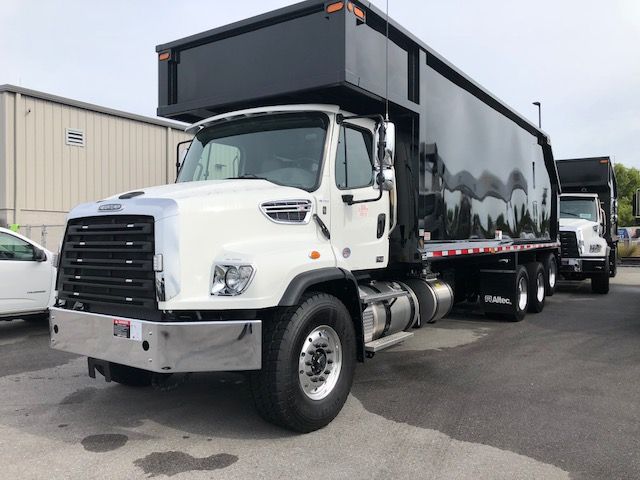
Have new freightliner grapple truck to sell? List it here to reach thousands of buyers.
About New Freightliner Grapple Trucks
The key buying decision is the complete upfit, not just the cab and chassis. A typical setup includes a hydraulic loader such as a Serco, Petersen, or Palfinger/Epsilon unit, paired with a high-capacity body in the 40 to 65 yard range. Hardox or other abrasion-resistant body materials are common when the truck will see heavy demolition debris or repeated impact loading. Buyers should pay close attention to boom reach, lift capacity at full extension, stabilizer design, hydraulic reservoir sizing, and control layout. For productivity, the right loader geometry can matter as much as horsepower, especially when the truck is working tight urban routes or loading over high side walls.
Freightliner chassis are popular in this segment because parts support is broad and the platform can be tailored for demanding vocational work. Engine ratings often land in the 350 to 505 horsepower range, with Detroit power common on severe-duty specs, and automatic transmissions are widely chosen for stop-and-go operation. Tri-axle configurations are common when higher legal payload and larger debris bodies are required, but axle ratings, bridge law compliance, and turning radius still need to match the territory the truck will run. Rear hitches, full fenders, heavy front bumpers, PTO integration, and engine brakes are frequent considerations on grapple builds that see mixed road and jobsite use.
A new unit makes the most sense when the goal is to standardize a fleet, reduce early-life maintenance, and get exact body and loader specs for the material stream being handled. The best build depends on what the truck grabs all day. Brush and storm debris call for different grapple tines and body volume than scrap or dense C&D loads. Buyers should also evaluate cab style, visibility from the operator station, frame reinforcement, and service access around the hydraulic system. On a grapple truck, daily production comes from how well the chassis, loader, body, and legal weight package work together.
Frequently Asked Questions
What is the most important factor when buying a new Freightliner grapple truck?
The most important factor is how the chassis and upfit work together as a complete package. Loader brand and model, boom reach, body size, axle ratings, PTO setup, and frame reinforcement all affect real productivity more than a cab-and-chassis spec sheet alone. A truck built for brush and storm debris can be a poor match for dense demolition material, so the body, grapple, and legal payload capacity need to fit the intended material stream.
What Freightliner chassis is most common for grapple truck applications?
The Freightliner 114SD is one of the most common severe-duty platforms used for grapple truck builds. It is popular because it supports heavy vocational suspensions, strong axle ratings, PTO-driven hydraulic systems, and wheelbase options that fit large debris bodies and loader installations. In heavier configurations, buyers often look at tri-axle setups for additional payload capacity and better weight distribution.
How large are grapple truck bodies on new Freightliner builds?
Body size varies by application, but many new grapple trucks are spec'd with debris bodies in roughly the 40 to 65 yard range. Higher-volume bodies are common in storm cleanup, municipal debris, and tree service work where the material is bulky but relatively light. Dense materials such as scrap or C&D debris may require a different balance of body volume, body material thickness, and axle capacity to stay productive while remaining legal on weight.
Are automatic transmissions a good choice in a grapple truck?
Yes. Automatic transmissions are common in new grapple truck specs because these trucks spend a lot of time in stop-and-go service, short moves between picks, and tight jobsite maneuvering. An automatic can reduce driver fatigue, simplify operation across multiple operators, and help maintain consistent performance in urban or residential collection work. The right transmission still needs to be matched to engine torque, gross vehicle weight rating, and PTO requirements.
What should buyers look for in the grapple loader itself?
Buyers should focus on boom reach, lifting capacity at different extensions, cycle speed, stabilizer design, control placement, and parts support. Reach and loader geometry affect how easily the operator can work both sides of the truck and load over tall body walls. Stabilizers matter for safe operation on uneven ground, and control layout affects operator fatigue over a full shift. The right grapple attachment also depends on whether the truck will handle brush, mixed waste, logs, scrap, or demolition debris.