
Freightliner Cab and Chassis Trucks For Sale in Massachusetts
Freightliner cab and chassis trucks for sale in Massachusetts. Compare M2 and SD specs, engines, GVWR, 4x2–6x4, brakes, wheelbases for plow, dump, delivery.
Learn more
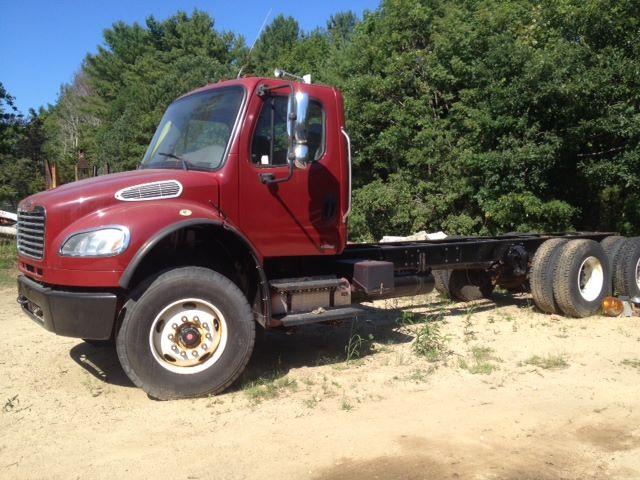
Have freightliner cab and chassis truck to sell? List it here to reach thousands of buyers.
About Freightliner Cab and Chassis Trucks in Massachusetts
Spec decisions in Massachusetts often revolve around winter operations and tight urban work. A set‑back front axle improves turning in Boston and Worcester, and shorter wheelbases help with alley access and roundabouts. For municipal plow/sander duty, a 14k–20k front axle, heated mirrors, engine block heater, and high‑capacity alternator are practical. Road‑salt exposure makes corrosion protection critical: e‑coated frames, undercoating, stainless fasteners and exhaust hardware, sealed electrical connectors, and aluminum fuel/air tanks all pay off. Air disc brakes improve wet‑weather stopping and reduce fade on the grades leading into the Berkshires; automatic traction control and interaxle lockers help in slush and on jobsite approaches.
Match chassis to body and payload early. Single‑axle 4x2 frames with 19.5 or 22.5 in rubber are efficient for 12–18 ft dumps, service bodies, and 24–26 ft van bodies, while 6x4 tandems with 40k–46k rears and double‑channel frames carry heavier hoists, cranes, and demolition bodies. Freightliner frame RBM and section modulus options allow stout hoist subframes without overstressing rails; confirm back‑of‑cab clearance, battery box and DEF/fuel tank placement, and driveline angles before finalizing PTO shafts and hydraulic tanks. Choose suspension to fit the job: steel leaf for cost and stability, AirLiner for ride and fragile freight, or vocational rubber/Haulmaax‑style for off‑road articulation. Air brakes are common above 26k GVWR and simplify PTO/brake interlocks; hydraulic brakes fit non‑CDL specs but trade some service commonality.
Lifecycle costs favor widely supported components. Freightliner’s multiplexed electrical architecture and clear body‑builder guides shorten upfit time, and Detroit/Cummins service coverage across New England supports uptime. Spec tire pressure monitoring, heated drain valves, and easily washed wheel‑end designs for winter maintenance. Think resale: Allison automatics, popular wheelbases, air brakes, and mainstream engine families help a Massachusetts unit appeal to contractors, municipal buyers, and regional carriers when it’s time to rotate equipment.
Frequently Asked Questions
Which Freightliner cab and chassis model fits a plow/sander and dump body for Massachusetts winters?
For combined plow/sander and dump work, the 108SD or 114SD Plus with a 16k–20k front axle, double‑channel rails where required, front frame extensions, and an Allison 3500/4500 with PTO is a strong choice. If weights are moderate, an M2 106 Plus with the L9, 14k–16k front axle, FEPTO, and air brakes can handle municipal routes while keeping overall length and turning radius tight for city streets.
Should I choose air or hydraulic brakes on a Freightliner cab and chassis?
Air brakes dominate above 26,000 lb GVWR due to better thermal capacity, easier integration of accessories, and broad parts availability. They do require CDL‑level familiarity and air system maintenance. Hydraulic brakes can be appropriate on non‑CDL builds for lighter payloads and lower initial cost, but they may limit wheel‑end and retarder options and can run hotter on hilly routes.
How do I pick wheelbase and CA/CT for my body?
Start with the body builder’s chart for your exact body and payload. As a general guide, 84–108 in CA suits many 12–14 ft dumps and service bodies, 120–138 in CA fits 16–18 ft platforms, and 186–190 in WB often supports 24–26 ft van bodies on an M2 106. Verify axle load compliance with your intended weight distribution, leave adequate back‑of‑cab clearance for hoists or hydraulics, and position fuel/DEF tanks to keep PTO and outriggers clear.
What engine and transmission pairing works best for stop‑and‑go urban routes?
For dense Massachusetts corridors like Boston and Cambridge, a medium‑displacement diesel with a broad torque band and an Allison automatic is ideal. The Cummins B6.7 or L9 and the Detroit DD8 paired with Allison 2500/3000/3500 series deliver smooth launches, fast shift logic on grades, and dependable PTO support for lifts and hydraulics. Consider a lower rear axle ratio for startability and engine braking.
How can I protect a Freightliner chassis from New England road salt?
Specify e‑coated or epoxy‑primed frames, stainless or plated hardware, sealed electrical connectors, and aluminum or composite air/fuel tanks. Add undercoating in high‑spray areas, choose air disc brakes to reduce corrosion‑related drag, and wash the chassis frequently with warm water. Heated mirrors, heated fuel filter bases, and a block heater improve cold‑start reliability and reduce winter wear.