
Freightliner Box Trucks For Sale in New Jersey
Shop Freightliner box trucks for sale in New Jersey. Compare M2 specs, box lengths, liftgates, GVWR, diesel power, and delivery-ready features.
Learn more
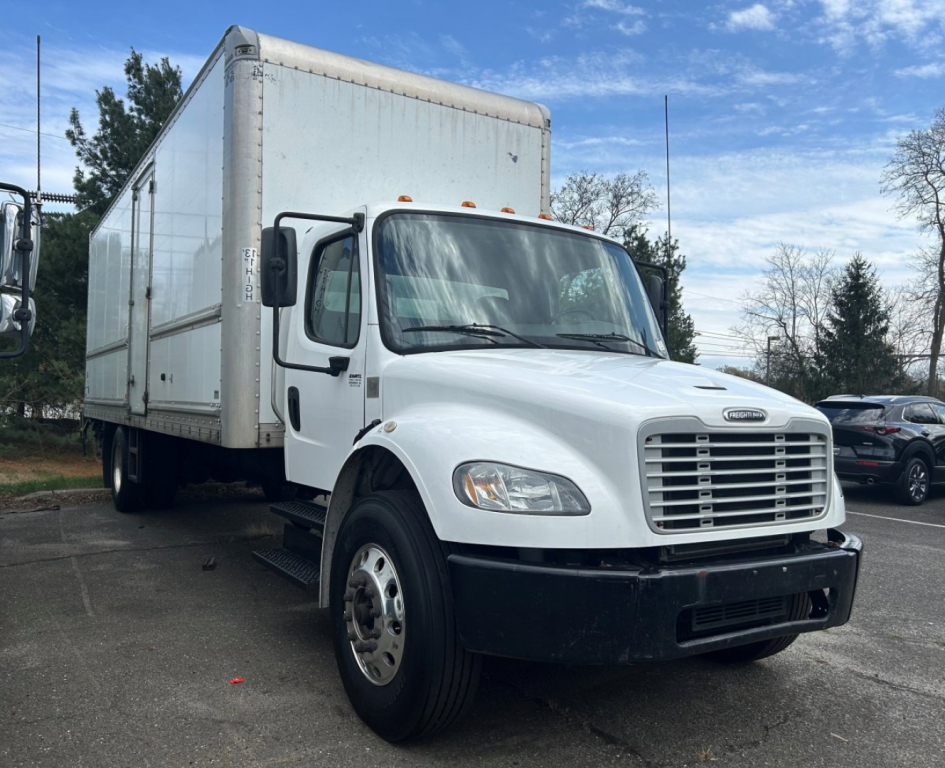
Have freightliner box truck to sell? List it here to reach thousands of buyers.
About Freightliner Box Trucks in New Jersey
The first buying decision is usually GVWR and body length. Many Freightliner box trucks are spec'd in the medium-duty range, often around Class 6 or Class 7, and that directly affects CDL requirements, payload, and bridge-law flexibility. A 26-foot box is a popular setup for furniture, appliances, retail freight, and route distribution because it maximizes cube without stepping into a full tractor-trailer footprint. If liftgate work is part of the job, pay attention to gate capacity, deck size, and how much usable rear clearance remains when the truck is dock loaded or working curbside.
Powertrain specs on Freightliner box trucks commonly include the Cummins B6.7 diesel paired with an Allison automatic transmission. That combination is widely used because it is familiar to fleet technicians and well suited to stop-and-go service. Air brakes and air ride suspension are common on heavier box truck specs and can improve control and ride quality with varying loads. Buyers should also look closely at wheelbase, rear axle ratio, fuel tank capacity, door opening dimensions, and the body build itself, including scuff liners, E-track, plywood lining, translucent roof, and floor condition. In New Jersey service, corrosion exposure, tight-route body damage, and frequent curbside loading wear are worth checking carefully.
Cab and operating features matter more than many buyers expect on a box truck that runs every day. Power windows and locks, heated mirrors, air conditioning, tilt-telescopic steering, and good visibility all help with driver retention and productivity on multi-stop routes. For buyers comparing Freightliner box trucks for sale, the most important fit questions are straightforward: how much cube is needed, how heavy is the freight, is a liftgate required, and how often will the truck operate in tight city environments versus longer suburban and regional runs. A properly spec'd Freightliner box truck can cover a broad range of delivery work while keeping maintenance, driver training, and operating costs predictable.
Frequently Asked Questions
What are the most common Freightliner box truck models and configurations?
The Freightliner M2, especially the M2 106, is one of the most common box truck platforms on the market. Typical configurations include 24-foot, 26-foot, and 28-foot dry van bodies with roll-up rear doors, curb-side entry doors, and optional liftgates. Most are medium-duty diesel trucks built for local and regional delivery service, with specs that can range from non-CDL setups to heavier Class 7 configurations depending on GVWR and body size.
Is a Freightliner box truck a good choice for city and final-mile delivery?
A Freightliner box truck is often a strong fit for city and final-mile work because the chassis is easier to maneuver than a tractor-trailer while still offering useful cargo cube and payload. The M2 platform is widely used for multi-stop routes, moving operations, retail delivery, and appliance or furniture transport. Buyers in dense markets like New Jersey should focus on wheelbase, turning radius, mirror visibility, liftgate function, and curb-side access because those factors affect daily productivity more than headline horsepower alone.
What engine and transmission are commonly found in Freightliner box trucks?
Many Freightliner box trucks are equipped with the Cummins B6.7 diesel engine and an Allison automatic transmission. This is a common medium-duty combination because it performs well in stop-and-go service and is familiar to many fleet maintenance departments. Exact horsepower, torque, and transmission ratings vary by spec, so buyers should match the powertrain to route density, average payload, highway exposure, and expected idling time.
What should I inspect on a used Freightliner box truck?
The most important inspection points include engine and transmission condition, brake type and wear, suspension, tire condition, liftgate operation, and signs of hard route use. On the body, check the floor, roof, front wall, scuff liners, rear frame, door seals, and dock impact damage. Also verify cargo box dimensions, GVWR, axle ratings, and any body manufacturer tags so the truck's actual capacity and dimensions match the intended application.
Do Freightliner box trucks require a CDL?
Some do and some do not. CDL requirement depends primarily on the truck's gross vehicle weight rating, not just the fact that it is a box truck. Many box trucks are spec'd at or below 26,000 pounds GVWR for non-CDL operation, while heavier configurations move into CDL territory. Buyers should confirm the door sticker, registration class, and intended load profile before purchase, especially if the truck will be used in a fleet with specific driver qualification limits.